Corporations are creating storyteller positions, but can this work?
A December 12th story in the Wall Street Journal ($)—”Companies Are Desperately Seeking ‘Storytellers’: Brands trying to wrest greater control of their narratives are asking for ‘storytelling’ skill sets—without a campfire in sight” by Katie Deighton—sparked a brief blaze of enthusiastic agreement on my LinkedIn feed.
Although this seems like good news for people who identify as storytellers and want to get good paying jobs doing so, I’m not sanguine.
Here’s an accurate 80 word summary by Claude (an AI) of the 932 word piece:
Corporate demand for “storytellers” has surged as companies bypass shrinking traditional media to create their own content. LinkedIn job postings mentioning “storyteller” doubled in a year, with roles offering up to $274,000. Companies like Google, Microsoft, and USAA are hiring storytellers to produce blogs, podcasts, and branded content that attract customers and control their narratives. The shift reflects journalism’s decline—reporter jobs dropped from 66,000 to 49,000 since 2000—while brands gained direct publishing channels through social media and newsletters.
Before I go any further, let me acknowledge that me talking about an excess of storytellers lands somewhere between irony and hypocrisy given that this is the 192nd issue of The Dispatch, and that this is far from the majority of the imposition of my prose upon an innocent readership over the last few decades.
This newsletter is, however, free, so you’re getting your money’s worth.
What makes a good story, anyway?
Two things: surprise and excess.
Surprise isn’t about plot. If it were, then nobody would ever go to see “THE Tragicall Historie of HAMLET Prince of Denmarke,” as the first (1603) edition of Shakespeare’s play described itself, because walking into the theater you already know that Hamlet won’t survive Act 5. Nor would we re-read books or watch movies again (and sometimes again and again).
Instead, surprise is about a narrative starting down one narrative path and then jumping onto another. The smallest unit of this is a joke.
Here’s a dirty one:
A husband and wife are cuddling on the couch. The lights are low. The curtains shut. Music on. Wineglasses are empty. The man begins investigating under the woman’s dress, but she gently pushes his hand aside. “I’m sorry, dear, but not tonight. I’m seeing the gynecologist tomorrow.” The husband kisses down her neck then back up again. He meets her gaze and asks, “are you also seeing the dentist tomorrow?”
Nothing kills a joke faster than explaining it, so I’ll only comment that I admire the husband’s quick thinking.
Excess is about how stories share more details than necessary to convey what happened. Murder mysteries are a good example. In his terrific 1988 book, The Novel and the Police, D.A. Miller observes:
The form is based on the hypothesis that everything might count: every character might be the culprit, and every action or speech might be belying its apparent banality or literalism by making surreptitious reference to an incriminating Truth.
However, later…
At the moment of truth, the text winnows grain from chaff, separating the relevant signifiers from the much larger number of irrelevant ones, which are now revealed to be as trivial as we originally were encouraged to suspect they might not be. (33-34)
In plain English, one pleasure in reading a mystery is holding multiple explanations in mind as you progress through the story, only to have all but one explanation drop into irrelevance at the end.
If you’re like me, then if you guess whodunit too early while reading a murder mystery, the rest of the book is a glum experience. I don’t think it’s just me, by the way, because there’s a famous theatrical anecdote about the long-running (70 years!) London play The Mousetrap by Agatha Christie. (Spoiler alert: skip to the next paragraph if you don’t know the story.) A taxi drops off a playgoer in front of St. Martin’s Theater. The passenger stiffs the cabbie on the tip. The cabbie rolls down his window and yells to the passenger, “the detective did it!”
If you laughed or winced reading that, then you get it.
What does this have to do with corporations hiring storytellers?
Corporations hate two things: surprise and excess.
Even pleasant surprises provoke executives to reach for the Pepcid worryingly asking themselves, “how did I miss this?” Nasty surprises can cost people, even CEOs, their jobs.
On excess, corporations worship at the altar of efficiency. Things need to be frictionless. Things need to scale.
Stories are inefficient, full of friction, idiosyncratic and therefore scale resistant.
Corporate storytelling is an oxymoron.
One more thing…
As we offload more decisions to AI, opportunities for these new corporate stories to reach human ears will decline. Businesses of all sorts now need to figure out how to tell compelling stories to algorithms.
Note: If you would like to get articles like this—plus a lot more—via email, please subscribe to my free weekly newsletter.
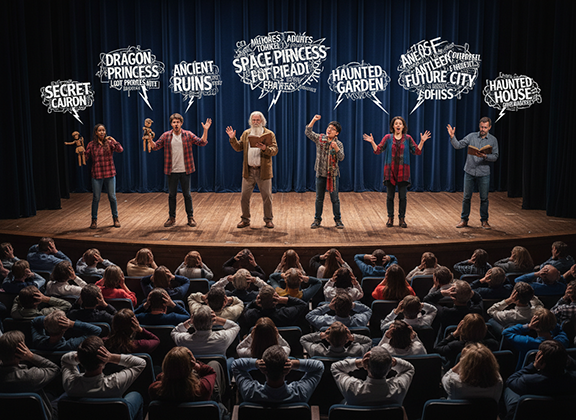
* Image Prompt: “Several storytellers of various ages, races, and genders stand on a stage, all telling different stories at the same time. In the audience, everybody has their hands over their ears.”
Leave a Reply