My annual journey across the books I read over the year. If you’re looking for a good read (or books to avoid) then you’ve come to the right place!
Happy New Year!
Note: Since this week’s issue is longer than most, your email might truncate it, particularly if you use gmail. At the truncation, just click “View entire message” to read the whole thing.
Top 3 Books of 2025 (the super short version):
Wright, Laurence. The Human Scale: a Novel. Finished 5/4/25.
Harari, Yuval Noah. Nexus: A Brief History of Information Networks from the Stone Age to AI. Finished 8/21/25.
Liu, Ken. All That We See or Seem: a Julia Z Novel. Finished 12/3/25.
I. Overture (before we get to the book lists)
This is the twelfth year that I’ve kept a running list of every book I’ve completed for the first time (or a re-read after many years or with a new context) and then shared that list as the first thing I post in the new year. It’s only the fourth time I’ve done so in this newsletter because I launched The Dispatch at the end of January, 2022.
One reason I do this is that it helps me chart the course of a yearlong intellectual and emotional journey. I read a lot of things that aren’t books: newspapers, magazines, newsletters, reports, and comic books, but books are different.
If you’re curious about previous lists, then you can see the 2024 list here, the 2023 list here, the 2022 list here, the combined 2021 and 2020 lists here, the 2019 list here, the 2018 list here, the 2017 list here, the 2016 list here, the 2015 list here, and the first list from 2014 here.
As always, thanks to my friend David Daniel for the inspiration to do this.
The links to buy the books are typically to Bookshop.org for paper books and Libro.fm for audiobooks. Amazon gets enough of our money, and Bookshop donates a slice of every purchase to a local bookstore of your choice.
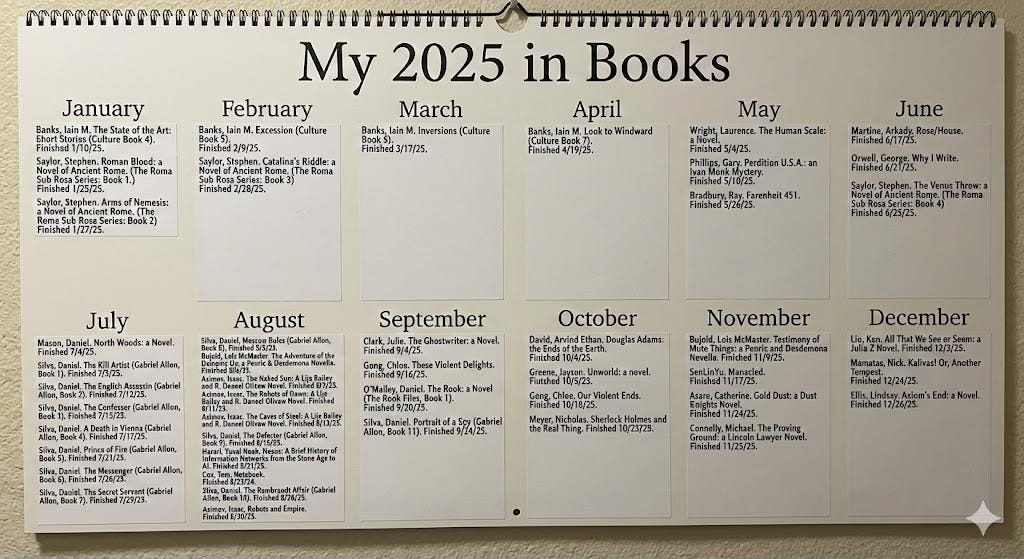
I read 46 books in 2025. My friend Peter Horan accounts for nearly a third of these books because he introduced me to two series and then gobbled up large chunks of them. His list is more curated than mine, and you can find it here.
What follows immediately below is the short list of authors, linked titles, and when I finished reading the book. The longer list with notes is below that, and a list of books I’m either reading at the moment or looking forward to in 2025 is at the end.
II. The Efficient List
1. Banks, Iain M. The State of the Art: Short Stories (Culture Book 4). Finished 1/10/25.
2. Saylor, Stephen. Roman Blood: a Novel of Ancient Rome. (The Roma Sub Rosa Series: Book 1.) Finished 1/25/25.
3. Saylor, Stephen. Arms of Nemesis: a Novel of Ancient Rome. (The Roma Sub Rosa Series: Book 2) Finished 1/27/25.
4. Banks, Iain M. Excession (Culture Book 5). Finished 2/9/25.
5. Saylor, Stephen. Catalina’s Riddle: a Novel of Ancient Rome. (The Roma Sub Rosa Series: Book 3) Finished 2/28/25.
6. Banks, Iain M. Inversions (Culture Book 6). Finished 3/17/25.
7. Banks, Iain M. Look to Windward (Culture Book 7). Finished 4/19/25.
8. Wright, Laurence. The Human Scale: a Novel. Finished 5/4/25.
9. Phillips, Gary. Perdition U.S.A.: an Ivan Monk Mystery. Finished 5/10/25.
10. Bradbury, Ray. Farenheit 451. Finished 5/26/25.
11. Martine, Arkady. Rose/House. Finished 6/17/25.
12. Orwell, George. Why I Write. Finished 6/21/25.
13. Saylor, Stephen. The Venus Throw: a Novel of Ancient Rome. (The Roma Sub Rosa Series: Book 4) Finished 6/25/25.
14. Mason, Daniel. North Woods: a Novel. Finished 7/4/25.
15. Silva, Daniel. The Kill Artist (Gabriel Allon, Book 1). Finished 7/5/25.
16. Silva, Daniel. The English Assassin (Gabriel Allon, Book 2). Finished 7/12/25.
17. Silva, Daniel. The Confessor (Gabriel Allon, Book 3). Finished 7/15/25.
18. Silva, Daniel. A Death in Vienna (Gabriel Allon, Book 4). Finished 7/17/25.
19. Silva, Daniel. Prince of Fire (Gabriel Allon, Book 5). Finished 7/21/25.
20. Silva, Daniel. The Messenger (Gabriel Allon, Book 6). Finished 7/26/25.
21. Silva, Daniel. The Secret Servant (Gabriel Allon, Book 7). Finished 7/29/25.
22. Silva, Daniel. Moscow Rules (Gabriel Allon, Book 8). Finished 8/5/25.
23. Bujold, Lois McMaster. The Adventure of the Demonic Ox: a Penric & Desdemona Novella. Finished 8/6/25.
24. Asimov, Isaac. The Naked Sun: A Lije Bailey and R. Daneel Olivaw Novel. Finished 8/7/25.
25. Asimov, Isaac. The Robots of Dawn: A Lije Bailey and R. Daneel Olivaw Novel. Finished 8/11/25.
26. Asimov, Isaac. The Caves of Steel: A Lije Bailey and R. Daneel Olivaw Novel. Finished 8/13/25.
27. Silva, Daniel. The Defector (Gabriel Allon, Book 9). Finished 8/16/25.
28. Harari, Yuval Noah. Nexus: A Brief History of Information Networks from the Stone Age to AI. Finished 8/21/25.
29. Cox, Tom. Notebook. Finished 8/23/24.
30. Silva, Daniel. The Rembrandt Affair (Gabriel Allon, Book 10). Finished 8/26/25.
31. Asimov, Isaac. Robots and Empire. Finished 8/30/25.
32. Clark, Julie. The Ghostwriter: a Novel. Finished 9/4/25.
33. Gong, Chloe. These Violent Delights. Finished 9/16/25.
34. O’Malley, Daniel. The Rook: a Novel (The Rook Files, Book 1). Finished 9/20/25.
35. Silva, Daniel. Portrait of a Spy (Gabriel Allon, Book 11). Finished 9/24/25.
36. David, Arvind Ethan. Douglas Adams: the Ends of the Earth. Finished 10/4/25.
37. Greene, Jayson. Unworld: a novel. Finished 10/5/25.
38. Gong, Chloe. Our Violent Ends. Finished 10/18/25.
39. Meyer, Nicholas. Sherlock Holmes and the Real Thing. Finished 10/25/25.
40. Bujold, Lois McMaster. Testimony of Mute Things: a Penric and Desdemona Novella. Finished 11/9/25.
41. SenLinYu. Manacled. Finished 11/17/25.
42. Asaro, Catherine. Gold Dust: a Dust Knights Novel. Finished 11/24/25.
43. Connelly, Michael. The Proving Ground: a Lincoln Lawyer Novel. Finished 11/25/25.
44. Liu, Ken. All That We See or Seem: a Julia Z Novel. Finished 12/3/25.
45. Mamatas, Nick. Kalivas! Or, Another Tempest. Finished 12/24/25.
46. Ellis, Lindsay. Axiom’s End: a Novel. Finished 12/26/25.
III. The Long List (with notes)
1. Banks, Iain M. The State of the Art: Short Stories (Culture Book 4). Finished 1/10/25.
I finished this book late morning the day after I returned from CES, getting to bed around 3:30am. Within the collection is a novella in the Culture universe called “The State of the Art” that features Diziet Sma, a central character in Use of Weapons, which was the last book I finished in 2024, although it is impossible to tell if this story takes place before or after Use. It seems like after because a drone character from Usecomments on the action via footnotes and an afterword, but the drone makes no reference to the events of Use and could be her (Sma’s) life long companion.
In “The State of the Art” novella, the human crew of one of then great sentient ships of The Culture comes to Earth to evaluate the planet. They immerse themselves totally in Earth’s history, present, across the entire planet. Linter, one of the Culture, decides to go native, which causes a lot of consternation for the Ship and some of the crew, and the Ship asks Sma to try to talk Linter out of staying behind. That’s one of the main narrative threads, and it’s interesting, but even more interesting are the meta-SF qualities of the long running debate among the crew about what to do about Earth given the—from their POV—violence, destructiveness, and general dangerousness of humans. At some points, the crew talk about this explicitly in terms of Star Trek, which they’ve become fond of, and they are aware of the differences between the Federation’s non-interference Prime Directive and their own penchant for massive interference.
The other stories are enjoyable, and the bizarre last story (which seems like a combination of the idiot’s monologue from Faulkner’s The Sound and the Fury and a collection of commercials, jingoistic phrases, and conversations in Scottish dialect) is fascinating, albeit I don’t know what to do with it.
I’m now very eager to read the next Culture book, Excession, which I may try to pick up at Powell’s later. Oddly, it is not available in e-book form, or I would have downloaded it to read on the plane ride home from Vegas last night. That would have been a waste since I fell asleep shortly after takeoff.
2. Saylor, Stephen. Roman Blood: a Novel of Ancient Rome (The Roma Sub Rosa Series: Book 1). Finished 1/25/25.
Fantastic murder mystery / detective story set in the Rome of Sulla the Dictator and Cicero. Peter Horan recommended the series at dinner on Wednesday. Both Kathi and I were interested. I bought the Kindle version and finished it a few minutes ago. (It’s 8:45pm as I type this.)
The detective is Gordianus the Finder, an investigator for hire, much like a private detective before such a term existed. He is dogged in his pursuit of truth, which is hard to find in a hyper-political, intrigue-filled place like Ancient Rome. I’m so excited by this book that I’m about to buy #2 in the series, even though I have another book that I’m in the middle of…
3. Saylor, Stephen. Arms of Nemesis: a Novel of Ancient Rome (The Roma Sub Rosa Series: Book 2). Finished 1/27/25.
My happy momentum from reading the first and buying the second within moments of finishing the first kept me going, and I read this one quite quickly over the course of a day and a half.
However, #2 was disappointing compared to the first at a plot-architecture level. Where #1 had a pair of hidden-in-plain-sight twists that surprised me, in #2 the big reveal was more like the end of a Scooby Doo cartoon: “I would’ve done it too if it weren’t for you, you meddling Gordianus the Finder!” Don’t know if I’ll keep reading the series… Kathi started #1 but found the narrator’s voice too contemporary for her taste. Fair, although it didn’t bother me.
4. Banks, Iain M. Excession (Culture Book 5). Finished 2/9/25.
I’m still loving this series. The word epic doesn’t quite cover the scope of Banks’ imagination. However, this one needed more visits from Basil Exposition, as I found myself lost in the complexities of a plot with too many characters that were insufficiently distinct, particularly the AI “Minds.” Still loads of fun, and I’m eager to find the next one. These books are oddly unavailable on Kindle.
5. Saylor, Stephen. Catalina’s Riddle: a Novel of Ancient Rome (The Roma Sub Rosa Series: Book 3). Finished 2/28/25.
Longer than the others and more satisfying.
6. Banks, Iain M. Inversions (Culture Book 6). Finished 3/17/25.
An intriguing departure from the rest of the series…
7. Banks, Iain M. Look to Windward (Culture Book 7). Finished 4/19/25.
I’m definitely in a rut, but I enjoy the rut because I love both of these series. This one, like the rest, is sprawling and ambitious yet intimate at the same time. I only have three more in Culture, so I may take a break to spread the joy out a bit. On the other hand, I’m terrible at doing that, so who knows.
8. Wright, Laurence. The Human Scale: a Novel. Finished 5/4/25.
A top 3 book. Astonishing. Wright is one of my favorite non-fiction writers, and I was thrilled to learn that he had written a novel. What makes this novel so powerful is its urgency, balance, and timeliness. It set in the Middle East, square in the middle of the War in Gaza.
What Wright does so powerfully is to alternate among different, incompatible, but compelling points of view. Some of the protagonists are Israeli, and some are Palestinian. It is an extraordinary mosaic that left me with a more powerful empathy for—and perhaps understanding of—the seeming inescapability of the conflict. It is also startlingly current. The story ends with events that were, I presume, quite new when Wright began writing the book, or intervened in his process and caused him to pivot to a new ending. I would love to know which. I’ll read this book again. I read it the first time for the story. I’ll read it again for his technique. High recommend.
9. Phillips, Gary. Perdition U.S.A.: an Ivan Monk Mystery. Finished 5/10/25.
Second in a terrific series, the first of which, Violent Spring, I read last year. An older mystery, first published in 1995, when dial-up internet was new and feature mobile phones were still a big deal. Monk is a terrific character. Things happen to him rather than just around him, as is the case with so many mystery protagonists. The series is unapologetically political, dealing with racism, politics, gay rights, white supremacy, and more. I’m saving the next one for a plane flight.
10. Bradbury, Ray. Farenheit 451. Finished 5/26/25.
I read this book decades ago and didn’t remember much of it. The current political climate with rampant anti-intellectualism, book banning, and attacks on higher education (all education, really), prompted me to pick up a copy and revisit the book.
Bradbury is prescient in many ways, albeit constrained by the technology of his experience. He foresaw our tendency to lock ourselves away from the real world in favor of the pseudo-reality of our screens, but instead of mobile phones people sit in their homes looking at televisions that take up one, two, three, and sometimes four entire walls. The protagonist’s wife, Mildred, sleeps every night with seashell devices in her ears that scarily anticipate AirPods. I need to re-read this book soon in order to understand it more fully.
The 60th Anniversary edition, which is the one I bought, has a generous amount of commentary and scholarship after the end of Bradbury’s short novel. I read all of it and learned from it, but I also wish that there had been a more obvious distinction between the novel and the criticism. I wish, in other words, that I’d had time to sit with the end of the novel for a while, but I turned the page and didn’t realize at first that the novel had, indeed, ended.
11. Martine, Arkady. Rose/House. Finished 6/17/25.
I loved her epic two-parter, A Memory Called Empire and A Desolation Called Peace, which I read back to back in 2023. This is a lovely haunted house novella with a possibly sentient AI at the center of the story. I inhaled it on a plane ride.
12. Orwell, George. Why I Write. Finished 6/21/25.
I picked this up on impulse at Annie Bloom‘s. It’s a little book that contains four essays, one a long treatise about England and how (to win WW2) it should embrace Socialism. This was not one of Orwell’s best predictions.
The last essay is “Politics and the English Language,” a favorite and one I used to teach At Cal. Revisiting it this time, I still agree with Orwell’s six rules for clear, muscular, and effective writing, but this time around I wish he had started the essay with these rules rather than ending with them. By describing what to look for in writing, what came after would make more sense, and the reader might have been hungry for it.
13. Saylor, Stephen. The Venus Throw: a Novel of Ancient Rome. (The Roma Sub Rosa Series: Book 4) Finished 6/25/25.
Fourth in the terrific “Gordianus the Finder” ancient Roman mystery series that Peter Horan suggested months ago. I got this one as an ebook because I’ve been traveling, which is convenient but also means that I have no real idea how long the book is. (I’ll look it up.) This story kept me guessing until the very end, filled with plot twists and remarkable characters.
The series is getting better the further it goes on, which is unusual for a mystery series. They usually become self parodies because the author doesn’t let the characters change over time. That is not the case here.
Note: the hardback first edition was 306 pages long, per a Google query.
14. Mason, Daniel. North Woods: a Novel. Finished 7/4/25.
My friend Leslie recommended this to me a few months back, and I enjoyed it. This was a multi-modal reading experience, as I flipped back and forth between reading a physical, hardback copy of the book and listening to the audiobook (read by 10 different narrators), which was available as part of my Spotify subscription. I might not have finished it without the option of continuing to make progress while doing chores, driving places, etc.
It’s a lyrical novel that combines a sweeping centuries-long story with magical realism. North Woods reminded me at different times of different other works. First, “The Doll’s House” arc of Neil Gaiman’s The Sandman comic where (spoiler alert) one of the main characters, an escaped dream, turns out to be a place in dreamland rather than a person. (This arc was also part of the first season of the Netflix series, of which the second season has just debuted. I wrote about how conflicted I am about watching it here.) The reason North Woods reminded me of The Sandman was that it is the story of a place rather than of people. I also thought about Robert Holdstock’s Mythago Wood, which was about the last acre of untouched forest in England and the magical things that happened there. Lastly, I thought about David Mitchell’s Cloud Atlas with its surprisingly connected stories.
North Woods is textured, with many different voices and sorts of narrative, complex, and vivid. I’m glad I read it, although I’m not darting off to read more of Mason’s books at the moment.
Note: I thought that I’d read less this year than last by a lot, but by this point last year I’d read 15 books versus 14, which isn’t much of a difference. 22 in 2023; 23 in 2022; 11 in 2021; 13 in 2020; 19 in 2019… so I’m all over the place.
15. Silva, Daniel. The Kill Artist (Gabriel Allon, Book 1). Finished 7/5/25.
First in a series of thrillers featuring Israeli master spy Daniel Allon, a Bondian figure who comes out of retirement after his arch enemy, Palestinian terrorist Tariq, assassinates an Israeli ambassador. Peter Horan recommended this series more than once, and I inhaled the first one in about a day… terrific, high speed plot, well-drawn characters. I got this out of the library as an ebook, and bought a bundle of 1-4 on Amazon when I realized my library didn’t have an ebook of #2.
With the War in Gaza raging, it was a bit hard at first to read a thriller so unambiguously on the Israeli side, but that’s the nice thing about the willing suspension of disbelief… it’s easy to do.
16. Silva, Daniel. The English Assassin (Gabriel Allon, Book 2). Finished 7/12/25.
Just as good as the first, although less of a surprise because just two books in some of the formula is becoming visible (if I’m right).
I called Allon “Bondian” in the last note, and it’s worth digging in a bit. It’s the Daniel Craig melancholy version of Bond that Allon most resembles. I’ll keep going.
17. Silva, Daniel. The Confessor (Gabriel Allon, Book 3). Finished 7/15/25.
These go down like a smooth Scotch.
18. Silva, Daniel. A Death in Vienna (Gabriel Allon, Book 4). Finished 7/17/25.
This one dealt with Allon’s own history in a new and engaging way. Can I hold off on #5?
Nope.
19. Silva, Daniel. Prince of Fire (Gabriel Allon, Book 5). Finished 7/21/25.
Started it on a plane from Burbank to Portland and finished it the next day.
20. Silva, Daniel. The Messenger (Gabriel Allon, Book 6). Finished 7/26/25.
21. Silva, Daniel. The Secret Servant (Gabriel Allon, Book 7). Finished 7/29/25.
This is almost embarrassing.
22. Silva, Daniel. Moscow Rules (Gabriel Allon, Book 8). Finished 8/5/25.
The longest and most ambitious of the series—an intricate, well-plotted story with a cluster of new characters, some of whom we might see again.
23. Bujold, Lois McMaster. The Adventure of the Demonic Ox: a Penric & Desdemona Novella. Finished 8/6/25.
A new novella by my favorite living science fiction and fantasy author is always a cause for celebration and a complete lack of discipline. I read this quickly, and I loved it as usual.
No spoilers here, but one of the most interesting things structurally or narratively about this story is that it flits from point of view to point of view. This is not something that Bujold always does, although she did it most memorably in her Vorkosigan universe novel A Civil Campaign. Her ability to move from one character’s perspective to another is Austenian. In this case, she moves between Penric’s point of view, and the points of view of two of his kids. Oddly, I don’t think we ever get the point of view of Desdemona, the demon that shares a body with Penric. I never noticed that before.
24. Asimov, Isaac. The Naked Sun: A Lije Bailey and R. Daneel Olivaw Novel. Finished 8/7/25.
The second in the series. A re-read after decades. I had a thought while reading Harari’s Nexus that reminded me of this series and one key plot wrinkle. I found the book available on Libby and downloaded it, read half of it, realized it wasn’t the book I was thinking about, but then finished it anyway. I suspect the book I am thinking about it is The Robots of Dawn, the third book in in the trilogy…
25. Asimov, Isaac. The Robots of Dawn: A Lije Bailey and R. Daneel Olivaw Novel.Finished 8/11/25.
The third in the series, another re-read after decades. I’m still looking for the story that I thought of while reading Harari’s Nexus about how a murder depends on a Spacer’s accent.. it’s probably The Caves of Steel, the first in the series. I’d be upset except that I enjoyed re-reading, both of these two books. About halfway through Robots of Dawn, I remembered the closing conversation that revealed all the secret bits that were adjacent to the central mystery but also the solution. The story was still sufficiently interesting for me to keep reading. Not a huge surprise: I know how Hamlet ends before I start reading or watching it, after all.
There are two clear differences between The Robots of Dawn and the previous two books in the series.
The first is length: Robots of Dawn is close to three times the length of the other two, which is because the first two were serialized, whereas by the end of his career Asimov had no such need to conform to a monthly magazine’s rules.
The second difference is that in Robots of Dawn Asimov is working to connect his Robotstories with his Foundation stories, including references to The Bicentennial Man, in order to create a gigantic narrative tapestry formed by all his works. Robert A. Heinlein did something similar with his last few books.
Looks like I’ll have to go back and re-read The Caves of Steel, which, if I’m remembering it correctly, was the most filmable of the three.
26. Asimov, Isaac. The Caves of Steel: A Lije Bailey and R. Daneel Olivaw Novel. Finished 8/13/25.
The first in the series, and still not the story I remember. I will find it. This was the most satisfying mystery of the three. The action sequence with Bailey and Olivaw escaping pursuit by hopping from moving strip to strip (mass transport in this future version of Earth) is indeed cinematic.
27. Silva, Daniel. The Defector (Gabriel Allon, Book 9). Finished 8/16/25.
Terrific. Intense. Intricate. The series stays high quality, which is rare. How can there be 25 of these? How can there be no streaming adaptation??
28. Harari, Yuval Noah. Nexus: A Brief History of Information Networks from the Stone Age to AI. Finished 8/21/25.
A top 3 book. A magnificent and maddening book that took me an endless amount of time to read, through several false starts and a lot of vigorous marginalia and notes. I’ve carried my copy all over the planet for months, so I feel joy at having turned the last page at 5:30am today, during my early morning reading over breakfast and coffee.
Harari connects the AI information revolution to previous information revolutions, including print, religion, the telegraph, and more. Like Richard Rorty’s contention that “there’s a there out there, but there isn’t truth out there,” Harari talks about key concepts as intersubjective realities and argues that information frequently privileges order over truth. I’m not doing justice to the depth of his arguments or the breadth of his scholarship, which I hardly could do in a brief note like this one.
Speaking of brief things, the presence of the word “brief” in the subtitle of the book is laughable. At more than 400 pages, this thing is a doorstop about which nothing is brief. Perhaps this is a quiet joke on Harari’s part in which he is working to create his own intersubjective reality where a tome can be brief based on the large swath of history it covers?
Side note: looking back over the books I’ve read this year, aside from a slim volume or Orwell’s essays Nexus is the only nonfiction book I’ve completed.
29. Cox, Tom. Notebook. Finished 8/23/24.
A lovely, strange, peripatetic collection of excerpts from the notebooks of an author about whom I’d heard nothing ever. I ran across it at the Manzanita Public Library book sale in June, when K and I were on the Oregon Coast for our anniversary. The book lured me in with “Sunday Times Bestselling Author” and the cover blurb “Always engaging, charming, funny, and often moving” by Stephen Fry.
I think I noticed, but did not process at the moment of purchase, that this copy is signed by the author. I did not notice that the book was crowdfunded until I read it.
Notebook is vast and fractal and unknowable in its Britishness. I’ve spent a lot of time in England, even a lot of time in Norwich, where many of the excerpts take place, but there were numberless incomprehensible things. This took nothing away from the book’s charm. It did, though, reinforce my Americanness. One tiny example, the author’s father, who in his telling always speaks IN ALL CAPS, received a gift of frogspawn from a friend at the gym. WTF is frogspawn, I wondered? A quick Google suggested that it might be pudding, but then it again it might be “the jelly-like clumps of frog eggs found in shallow ponds in the spring.”
Another nonfiction book, and a nice change of pace after Harari. Now the 10th Gabriel Allon novel has become available from our local library. I know what I’m reading in bed tonight.
30. Silva, Daniel. The Rembrandt Affair (Gabriel Allon, Book 10). Finished 8/26/25.
The next installment in this immensely gulpable series. Silva’s ability to twist the plot a third of the way through from an art theft caper onto something concerning global intelligence was remarkable craftsmanship. Hard to believe there are 15 more of these waiting for me.
31. Asimov, Isaac. Robots and Empire. Finished 8/30/25.
At last! The sequence I remembered and struggled to find was in this book, the last of Asimov’s books to deal with R. Daneel Olivaw, although it is not strictly part of the Lija Baley and Daneel Olivaw mysteries.
Sprawling, discursive, and enjoyable, this is part of Asimov’s late-in-life attempt to pull all of his different series into one big narrative: Robots, Foundation, and Empire. I’m not a fan of the Foundation books and never read the Empire books, so I’m not qualified to comment beyond, “why?” Heinlein did something similar, particularly with The Number of the Beast (1980), although he went on to write four more long books between Beast and when he died in 1988.
I wrote about the reason I re-read all these Asimov books here.
32. Clark, Julie. The Ghostwriter: a Novel. Finished 9/4/25.
As I mentioned here, I got this out of the library on a 14-Day loan, didn’t get around to it, peeked into it the day it was due, and was hooked. I drove to Powell’s, bought a copy, and read it in the scant time I’ve had to read this week because I have two conferences in Palo Alto next week.
Calling this a page turner is an understatement. I had to force myself to put it down, and I resented my need for sleep. Clark is a meticulous plotter, a fine stylist, and gets inside the emotions of her characters. The story is about a ghostwriter named Olivia who winds up writing the memoir of her father, a famous horror writer who everyone has believed to be a murderer for half a century. The story shifts among multiple first person points of view, each shedding light on the other. I read it in a hurry because I had to know what happened. I’ll re-read it to admire Clark’s technique.
I should also mention that it’s a beautiful book physically, with stylized illustrations on the sides of the pages. High recommend if you like thrillers.
33. Gong, Chloe. These Violent Delights. Finished 9/16/25.
I picked this up remaindered from the little Powell’s at PDX (the Portland Airport) en route to the Ascendant events in Palo Alto last week. A romantasy set in 1920s Shanghai with monsters and gangsters and a plague, all adapted from Romeo and Juliet? What’s not to like? Gong has another one based on Antony and Cleopatra that has been sitting on my shelf for a while. Now I’m motivated. She’s good. A more romance-y, less lit crit R.F. Kuang.
34. O’Malley, Daniel. The Rook: a Novel (The Rook Files, Book 1). Finished 9/20/25.
Terrific supernatural spy thriller recommended by Jim Louderback at the Digital Ascendant last week. The X-Men meets Slow Horses with a generous dash of Harry Potter. Well-crafted and fun. I’ll keep reading the series, but perhaps not instantly.
35. Silva, Daniel. Portrait of a Spy (Gabriel Allon, Book 11). Finished 9/24/25.
I wish I could say that I’ve been deliberately pacing myself on these because there are only 25 of them, but that’s not true. Comfortably retired, Allon can’t help himself from stepping in when he sees a terrorist about to act… whereupon he finds himself back in the spy game, à la Michael Corleone, “just when I think I’m out…”
36. David, Arvind Ethan. Douglas Adams: the Ends of the Earth. Finished 10/4/25.
A correction from issue #183 of The Dispatch: Last week, I wrote about a new intellectual audiobook biography of Douglas Adams and implied that the title was “Why Can’t Futurism Be Funny?” I was wrong. The title of the book is Douglas Adams: the Ends of the Earth by Arvind Ethan David. I listened to it in the days since the last Dispatch, and for any fan of Adams it’s a must-listen. David’s book gives Adams a much broader political, philosophical, and scientific context than just as a writer of funny science fiction books. I’m still digesting it.
37. Greene, Jayson. Unworld: a novel. Finished 10/5/25.
An interesting conceit that I enjoyed until a conclusion that I found unsatisfying, but I suspect that has more to do with my sensibilities than the book itself. Hmm, that doesn’t mean anything. Let me try again: I can be impatient with literary fiction, and that’s what this is despite the science fiction plot.
What can bug me about literary fiction is how so much nothing happens. That is not the case with Unworld, which features an intricate and well-structured plot with multiple, overlapping protagonists.
The spine of the story is about what happens when a woman, Anna, and her “upload” (an AI with all her memories) break up.
To Greene’s immense credit, he keeps the technobabble to a minimum and focuses on the emotions of the characters. I’ve seen the “upload” idea before, perhaps most memorably in the “White Christmas” episode of Black Mirror, but this version digs deeper. I need to keep thinking about this because I am more engaged with the book than I thought I was when I closed the last page a few minutes ago (on a plane from Portland to Los Angeles).
38. Gong, Chloe. Our Violent Ends. Finished 10/18/25.
Sequel to #33. This is a strong fantasy retelling of Romeo and Juliet set in late 1920s Shanghai. As a recovering Shakespearean (not that I’m trying all that hard to recover) the events of the play haunted my reading of this two-parter (with spinoffs as the “Secret Shanghai” series that I’ll read eventually). It’s enjoyable.
Gong is astonishingly prolific—seven novels at age 26?
39. Meyer, Nicholas. Sherlock Holmes and the Real Thing. Finished 10/25/25.
I stumbled across this at Diesel Books at the Brentwood Country Mart in L.A. a few weeks back. I’m a fan of Meyer’s work as a screenwriter and novelist. He wrote Star Trek II: the Wrath of Khan, which is the best Star Trek movie. His first Holmes novel was The 7% Solution, where Holmes goes to Sigmund Freud for treatment of his cocaine addiction. He has written several others, but I think the only one I’ve read was The West End Horror that featured Oscar Wilde.
This latest, and Meyer’s last per his author’s note, Holmes pastiche is a fast-paced mystery about art theft and art forgery. Since I’ve read so many of the Gabriel Allon books this year, another mystery about the art world—but this one in Victorian England—was cool.
Back in grad school, I wrote an immense paper about Holmes as a narrative agent rather than a character, with a focus on non-Doyle Holmes pastiches featuring other famous literary and historical figures, so this is an ongoing interest.
40. Bujold, Lois McMaster. Testimony of Mute Things: a Penric and Desdemona Novella. Finished 11/9/25.
Another Penric and Desdemona novella in one year? That’s cause for celebration. This time, Bujold travels back to several years before The Adventure of the Demonic Ox (from earlier this year) for an adventure before Penric settled down. It’s an enjoyable, quick read: Penric as detective more than Penric as action hero.
As a longtime Bujold reader, I took some pleasure in noticing some parallels between Constable Dena, a new character, and her most famous character, Miles Vorkosigan.
I read everything that Bujold writes, and I like the Penric and Desdemona stories. Penric, though, is not her best character. Bujold excels at creating characters who are deeply damaged and trying to make their ways despite the damage. Miles is the apogee of this, although there are many others, particularly in the Vorkosigan books. Penric is just too darned healthy to be as compelling a figure.
41. SenLinYu. Manacled. Finished 11/17/25.
I wrote about this at some length here: a Romantasy, Harry Potter fanfic focusing on a dystopian love story between Hermione and Draco. The fanfic proved so popular that a de-Potterized version, Alchemised, is now a bestseller. I’m so curious about the difference that I’ll probably read it, too.
Manacled is a solid book. Very long, but once I got into it, I moved quickly. For Potter fans, there’s a lot to like. The plot starts very bleak, but then things start to make sense about 1/3 of the way through. A definite “no way” to anybody sensitive to depictions of rape and violence.
42. Asaro, Catherine. Gold Dust: a Dust Knights Novel. Finished 11/24/25.
The latest in Asaro’s Major Bhaajan series, itself a paraquel for her long-running Skolian Empire space opera. At nearly 500 pages, this one was longer and more intricate, with more plots than usual. Bhaaj’s plucky group of talented young people from “the Undercity,” a mysterious alternative culture, emerge into daylight to compete in the intergalactic Olympics. Fast-moving and fun, despite its length. This is not a place to jump onto the series because much of it won’t make sense, but the previous one (The Down Deep, which I read last year) is.
43. Connelly, Michael. The Proving Ground: a Lincoln Lawyer Novel. Finished 11/25/25.
I’m a Connelly fan, although not an obsessive completionist because the guy is so prolific. (I love Ballard on Prime Video and The Lincoln Lawyer on Netflix, too.)
This is one of Connelly’s more ambitious recent novels because he has Mickey, the lawyer, take on an AI company that creates chatbots, one of which provoked a teenager to kill his ex-girlfriend. This is as hot-from-the-presses as novels get, and it resembles the tragic story of Sewell Setzer III, which I’ve written about here and other places. Connelly’s prose goes down like a glass of The Dalmore Cigar Malt Reserve on the rocks, smooth and satisfying.
44. Liu, Ken. All That We See or Seem: a Julia Z Novel. Finished 12/3/25.
A top 3 book. This had great blurbs, and I saw a comment or review in passing, but I confess that I was trepidatious about it because I only know Liu’s work from his translation of the impenetrable Three-Body Problem. I shouldn’t have worried. This is a fast-paced near-future thriller and mystery that also serves as the superhero origin story of Julia Z, the protagonist. Liu is fearless in his plot construction, doing things that I didn’t expect. An ordinary novel like this would have ended about 2/3 of the way through, but this one keeps going in unexpected and interesting directions. I’ll buy and read the next one immediately.
45. Mamatas, Nick. Kalivas! Or, Another Tempest. Finished 12/24/25.
Interesting and enjoyable science fiction re-imagining of Shakespeare’s The Tempest.Kalivas, the title character, is the equivalent of Caliban. The twist is that he is the sole remaining “free range human” in a post-apocalyptic future where the rest of the world’s population are augmented humans. The end is surprising. I started it with a library loan that ended, but I was so caught up that I rushed to buy a physical copy… and also wanted to support the author and Powell’s.
46. Ellis, Lindsay. Axiom’s End: a Novel. Finished 12/26/25.
Interesting SF first contact novel with some deep thinking about how different species can only know each other analogically. I nearly gave up in the middle, but I’m glad I went back to it. I’ve been in a series of reading ruts this year (Banks, Saylor, Silva), so a different author with a different sensibility—even if she was ploughing earth much tilled by others—was refreshing. It’s not a love story, quite, but the relationship between Cora, a young human, and Ampersand, an alien, is narratively elegant.
Of the 46 books I’ve read so far this year, only four are non-fiction… and one of those is a biography of Douglas Adams, a science fiction writer.
IV. Books I Look Forward to Reading in 2026
Here are a few books that I’m either in the middle of reading or want to read soon… and in no particular order:
Nobody’s Girl: A Memoir of Surviving Abuse and Fighting for Justice by Virginia Roberts Giuffre.
Slow Gods by Claire North.
Katabasis by R. F. Kuang.
Impossible Owls by Brian Phillips.
Tiny Experiments by Anne-Laure Le Cunff.
Alchemised by SenLinYu.
Thanks for reading! See you next Sunday for a more typical Dispatch.
*Image prompt: “A photorealistic picture of a twelve month calendar where at the top of the image is ‘My 2025 in Books’ and these titles are matched to the month in which they were finished.” I then appended “the efficient list” to get the resulting image. I immediately noticed Gemini’s ability to spell words correctly, which is different than most other ChatBots.
Leave a Reply