Today’s job market for recent college grads eerily resembles the academic job market in the 1990s: what are the lessons?
The great graduate job drought, a dejecting article by Anjli Raval from the Financial Times ($) arrested my attention this week. Recent college graduates face long and difficult job searches. In the U.K., there are 140 applicants per job, versus 86 per job in 2022-23. One applicant was told she was competing with 3,300 others. It’s the same story in the United States.
The piece is worth reading (you can get a few free articles with registration). Here are some poignant excerpts:
- “For many, the social contract feels broken: a traditional academic route no longer guarantees passage into a graduate-level job.”
- “Young people are delaying life milestones; buying homes and having children feels like a stretch for many.”
- “The crunch is prompting many graduates to reassess the value of a university degree itself.”
- “Those who are seeking stopgap jobs in hospitality and retail are often excluding their degrees from job applications.”
Scammers abound, charging big bucks for help getting jobs, and other scammers create fake jobs at fake companies or bait-and-switch tricks for the desperate. One young friend nearly moved to a new town for a gig with an ad agency that either didn’t exist or was a sales boiler room—instead of the highly paid marketing internship he’d been told he won.
The job market is even harder for people without college degrees.
Applicants are using AI to render their resumes desirable to employer AIs, making the whole process into the endless set of reflections when two mirrors stand across from each other, with a tiny human image vanishing into the distance.
We can blame some—but not all—of this on AI and the growing belief that in the near future algorithms will do the work that entry level humans do today. At the World Economic Forum in Davos this week, AI-induced joblessness was a big topic:
Anthropic CEO Dario Amodei said during a conversation at Davos that the tech industry is “six to 12 months” away from an AI model that can perform most, if not all, of the job functions of a software engineer.
During the same chat, Google DeepMind CEO Demis Hassabis predicted that we’ll begin to see AI impacting internships as well as entry-level and junior-level jobs this year.
But the oversupply of jobseekers for a limited number of jobs pre-dates the AI revolution. This oversupply has allowed corporations to keep jobs open while waiting for the perfect candidate or take low-cost interns for low-risk test drives… because they can.
As I read the FT article, I realized that I’ve seen this movie before.
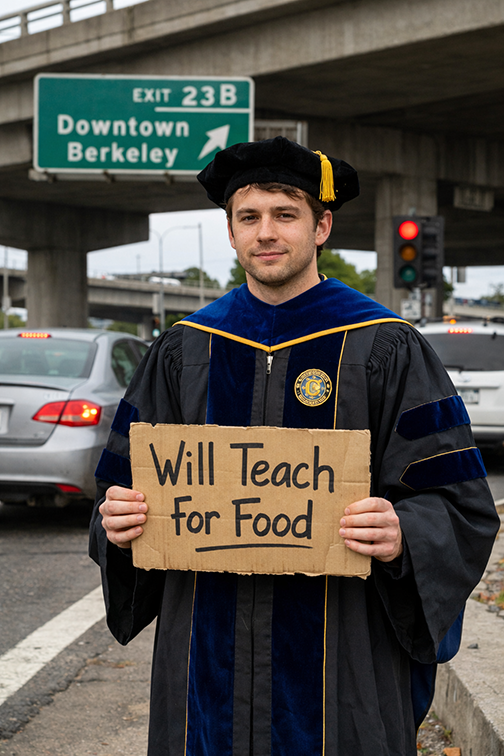
Will Teach for Food?
In the 1990s, after several years at U.C. Berkeley devoted to getting a Ph.D. in English with a specialty in Shakespeare, I realized that there were a vanishingly small number of jobs in my field: teaching English literature at a university level.
At that time, the January Modern Language Association (MLA) conference was the onlyplace to do job interviews, if you were lucky enough to get any. If you got no interviews and no job offers, then you had to wait an entire year before going up to bat again.
There were dozens, sometimes many hundreds, of applicants for a handful of jobs. Hiring departments could wait for perfect matches. If such a perfect match didn’t appear, the department could hire an adjunct for a year or two and try again.
The first years of a Ph.D. program are devoted to study: taking classes, prepping for oral exams, pitching a dissertation topic and then writing it. We also needed to learn to teach, although we were pretty much on our own for that. By the time my cohort surfaced and started looking at the job market, the news was grim: we could look forward (?) to a four-year job search. Even then, the job might be at a minor college in some wilderness.
At one such MLA, friends and I joked darkly about planning to hold up “Will Teach for Food” signs at the bottom of freeway offramps. Universities had so stacked the system against us that, I speculated, the only persuasive form of protest would be if—during an interview that was going badly—the applicant pulled a gun out of his backpack, stuck it in his mouth, and pulled the trigger. For the rest of the conference, whenever we passed each other, we would point imaginary finger guns into our mouths and grimace.
It remains deeply unethical for universities to admit astronomically more Ph.D. candidates than there are jobs, but universities, particularly top-flight ones like Berkeley, are addicted to the cheap labor that bright graduate students supply. Perhaps they delude themselves into thinking that their grad students will get jobs, but all you have to do is look at the math to see that it won’t happen for the majority.
Nearly 30 years later, I am still outraged by this.
Since my time, the academic job situation—particularly for folks in the humanities—has gotten much worse. With an oversupply of eager-to-teach people with advanced degrees, universities no longer need to offer tenure, which means that most faculty are job insecure—full time teaching academics at best; at worst, “freeway professors” who cobble together something shy of a living wage by teaching at multiple campuses.
Despite my outrage at the system that exploited me and so many others, I know that I am a lucky man.
I’m lucky because at the precise moment that I was coming out of my delusions about the academic job market, the internet appeared. It was a new frontier, and companies desperately needed people who could jump in and figure out how to do things that had never been done before… even if you were a nerdy, recovering Shakespearean. I’m also lucky because I am highly adaptive and was able to translate my skills into the new internet biz. My post-academic career has taken me all over the world across different jobs, companies, and adventures, and I’ve met terrific people everywhere I’ve gone. I’m aware this is not a common story.
Similarities and Differences
Although the shape of my academic experience back in the day is haunting in its similarity to what recent college graduates are facing today, there are key differences:
- Job-seekers with Ph.D.s represent a tiny fraction of the population; about a third of American kids get college degrees.
- Full-time jobs of any kind have declined over the last 25 years, forcing people into the gig economy, temping, seasonal work, and the like… without health insurance or savings to fall back on in case of a job loss, health crisis, or need to buy a new fridge.
- While the AI revolution might result in an explosion of new jobs, in the short-to-middle term most corporations are looking to AI to reduce headcount, not expand it.
Despite all of this, I remain hopeful. The world has changed incalculably in my lifetime, and the rate of change is only accelerating. Change is neither inherently good nor inherently bad: it’s just change.
The worst thing we can do is pretend that change isn’t coming. It is. Better to embrace it than deny it.
Note: to get articles like this one—plus a lot more—in your inbox, please subscribe to my free weekly newsletter.
* Image Prompt: Please create a photorealistic image of a man in his late 20s wearing the full regalia of a Ph.D. in English from U.C. Berkeley standing at the bottom of a freeway offramp. The man is holding up a cardboard sign that reads “Will Teach for Food.” Note, please, that the man in the image is not me.
Leave a Reply