Different tools can unleash different kinds of thinking, including fountain pens (a recent interest).
Lately, I’ve gotten into fountain pens. A couple years back, my friend Rob gave me a nice Pilot. Then, after they went to Paris on a long-delayed mother/daughter trip, Kathi and Helena brought back a Waterman for me. I had an antique Pilot Custom and a gold Dupont that my father (he’s a lefty and therefore finds fountain pens awkward) had handed down years before, but I never used them.
That changed when I discovered that writing with a fountain pen on nice paper (say, from a Moleskine notebook) at a table a bit distant from my digital devices (the iPhone in particular) would slow me down and help me to focus on working through an idea, solving a problem, or figuring out why something was troubling or exciting me. Fountain pens, as I’ve written elsewhere, have become part of my productivity stack.
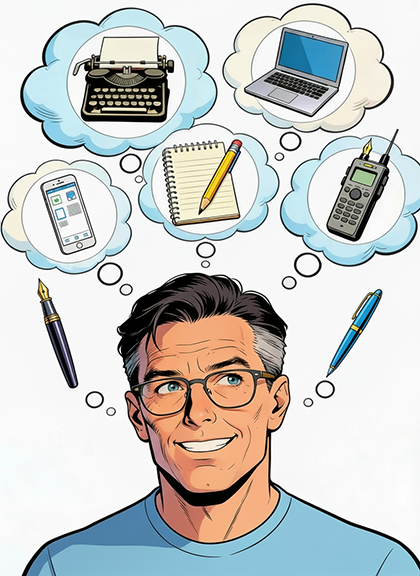
Of course, it’s not only fountain pens that can enable different sorts of thought. Sometimes, when I’m writing (a column like this one, an email, fiction) on a digital device and need to see things from a fresh angle, I might change the font and the margins. Or, I might print out the piece and go to another room, red pen in hand, to work it over.
Analog tools elicit different kinds of thinking than digital tools, especially when groups are working together in real time, in the same place. I can never say enough nice things about John Willshire’s Artefact Cards. These are blank playing cards, colored on one side and white on the other. When I lead face-to-face “let’s figure this out” workshops, having participants slide the cards around the table, organizing and reorganizing, putting ideas close to each other or moving them apart, pulls us deeper into collaboration because we vote with touch in a way that we don’t by mousing and clicking or pinching and zooming.
We also vote with touch in other ways. Reading an ink and paper book (a “book book” as my friend Peter Horan says) is different than reading a book on a tablet. I just finished Claire North’s magnificent novel Slow Gods, and I knew I was reaching the end because of the shifting weight of the paperback in my hands. In a kind and clever decision, Orbit, North’s publisher, added some “extras” at the back of the book but made those pages a different color to signal that they weren’t part of the novel, so I didn’t have that, “wait, I thought there was one more stair” lurching when I ran out of book before I expected.
Back to fountain pens: over the last few months, a handful of additional pens (two Nahvalur, one very indulgent Sailor, a whimsical purple TWSBI with purple ink, and one lovely but not terribly functional Yamanaka) have joined the toolbox.
Note, please, that I am but a humble Padawan when it comes to fountain pens. My friend Om Malik is a Jedi Master, as you can see on his Om Loves Pens Instagram account and the accompanying newsletter. There’s a Portland Fountain Pen Club that I haven’t visited because I don’t have much to say about the technical bits of fountain pens. (Yet.) On the other hand, in July the Pacific Northwest Pen Show will come to Portland, and that sounds like fun: the Rose City Comic Con of fountain pens.
What I’ve realized recently is that my initial velocity metaphor—fountain pens slow me down—is incomplete. It’s a topsy-turvy productivity notion because it’s about increased slowness rather than doing more faster.
But fountain pens change more than the amount of thought: it’s not just less or more. When I write with different fountain pens on different kinds of paper that also changes the flavor of thought. It’s both quantitative and qualitative.
One Nahvalur has a different sort of nib, and the ink flows faster into the paper of my Appointed notebook. The ink seeps deep into the paper so I can only use one side, but that’s fine because I find myself writing more slowly and with larger strokes, more playful with language, and switching between nimble cursive and more authoritative ALL CAPs. My thoughts range wider with this pen than with, say, the more precise Waterman.
The Sailor has a scratchy quality as the tip moves across the paper, like a cat’s sandpaper tongue licking my finger: the thinking it pulls out of me stands somewhere between the kaleidoscopic Nahvalur and the logical Waterman. I default to this pen because of the variety of thoughts it helps me think.
Digital technologies, AI in particular, tug us away from the intimate, sensual tango of our bodies and our minds across the stage of our work. With a few clicks, we can outsource the creation of a presentation to CoPilot. We can babble at Claude or Chat and get back adequate prose organizing our thoughts. It’s not bad that these tools exist because not every PowerPoint has to be a thing of persuasive beauty, and not every memo needs to marshal the best prose. Mark Twain said that the difference between the almost-right word and the right word in a sentence is the difference between the lightning bug and the lightning, but we don’t always need an electrical storm.
What we do need is the option, the ability to switch between slower, higher friction analog thinking tools and faster, slippery digital ones. At least I do. My fountain pens help me to preserve my technique, my ability to practice different flavors of thinking. Without them and other analog tools, I worry that I’d forget.
Note: If you’d like to receive articles like this one, plus a lot more, please subscribe to my free newsletter: The Brad Berens Weekly Dispatch.
* Image Prompt: I started with, “Please create this image: A comic book style illustration with a middle-aged white guy with gray temples and dark hair, wearing glasses. He has a contemplative look on his face. Thought clouds (like in comic books) surround him, each thought cloud contains a different writing tool: a typewriter, a laptop, a pencil, a ballpoint pen, a notebook, a fountain pen, a dictaphone, and anything else you can think of.” I then iterated with the AI for two rounds before getting the above result. ChatGPT never quite got the images right. Gemini did a nice job, but the result included a caption, “The Writer’s Mind,” that I didn’t ask for and didn’t like.
Leave a Reply