…if you can think analogically: a mini-memoir.
Last week, a young colleague and I visited La Profesora’s Digital Skills class at Portland State University. We were there to talk about career readiness and what my friend Rishad Tobaccowala, in his terrific book Restoring the Soul of Business, calls “the turd on the table.”**
In this case, the turd was that there is a job drought in the book publishing biz, which is the Masters program the class is in. My colleague and I were there to talk about other industries in which the skills these students develop are valuable, which increases their odds of getting jobs. My colleague is a recent graduate of the program, who now works with me at Ascendant Network.
I was there because my screwy career has had many pivots, and some of the lessons those pivots have taught me are worth sharing. As I was finishing grad school, I had a similar “wait a second…” moment when I realized that there was a 90% unemployment rate in my chosen field, which I recently described in Will Teach for Food.
The most important lesson is the power of analogy.
During my first career pivots, I’d think, “well, I guess I’m starting over. Nothing that I’ve been doing will have any bearing on this next phase.” I was always wrong about this.
What I learned is that if you can think analogically, then no experience is wasted. Instead, those experiences become fuel for your future. Analogy—our ability to compare vastly different things to each other and then pull meaning out of the comparison—is a key human ability. It may be one of the few things that will continue to distinguish human intelligence from the artificial kind.
Here are two examples of how analogy changed my life and accelerated my career during transitions.
#1: The New Editor in Chief
In the fall of 2004, iMedia Communications hired me to become its Editor in Chief. At that time, iMedia Connection was a daily newsletter and website covering the intersection of the internet and media. I had little idea how to be an EIC.
But I got lucky. Lee Watters, the man leaving the job to chase other adventures, masterfully led the handoff. I watched him work for a few days. Then he watched me work for a few days. Then he left but was available for shawarma and questions. This is akin to the old “watch one, do one, teach one” process in medical school, plus Mediterranean food.
Over those initial few days, the material was different, but the process started to feel like grad school. To my surprise, running a daily media property was similar to getting a Ph.D. in Shakespeare studies while teaching: the scale was just a lot different. Deadlines came faster, and there were more of them; the length of each piece was tiny; there were hyperlinks instead of footnotes, and no bibliographies.
Once I had the “journalism is like scholarship, but faster” analogy in my head, everything got simpler.
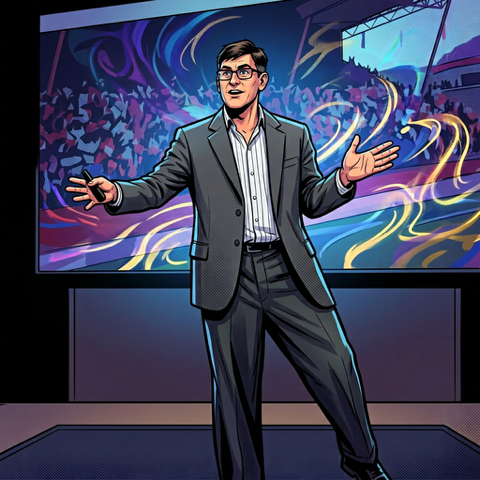
#2: The Man Onstage
A few months later, iMedia and Variety were co-producing an event about entertainment marketing (how to get people to go to the theater, turn on the TV, or, back then, buy a DVD). As we sat around a conference table pulling together an agenda, we realized that we needed a research presentation: somebody to talk about how the internet, particularly the web, changed how audiences found out about and consumed entertainment. Nobody had an immediate idea about who should do this.
“I’ll do it,” I said. Quizzical looks then ping-ponged around the table, and I had my first experience with telepathy because I could see what my colleagues were thinking. “Can he do this?” “Well, he does have a Ph.D.” “It’s a 15 minute presentation—how much damage could he do?” I got the gig.
Digression: as I said to La Profesora’s students last week, “I’ll do it” are three of the most career advancing words you can ever say. The time to say them is a moment just after people have realized that a job needs to get done, but nobody is quite sure what the job is or who can do it. Saying “I’ll do it” is high risk/high reward. (I once said these words about a corporate website redesign on the second day at a new job, but that’s a story for another mini-memoir.) End of digression.
Having the research presentation assignment, I now had to figure out three things:
- What I was going to say.
- How to use PowerPoint, which I had never done.
- Who I was going to be onstage.
The last was the most important. I understood the overall trends well, and PowerPoint was a steep but short learning curve. But my onstage persona needed to deliver the goods for that event’s audience, and it was going to send a message to my colleagues and the industry at large about my abilities for the future.
As I shuffled through my different experiences, the question I asked myself was “who does the audience need me to be? And what is the closest experience I have to that person?”
As a grad student back at Cal, I was the only teacher who insisted that my students call me “Mr. Berens” rather than “Brad” because I wanted them to take the class seriously. If my peers channeled Mr. Rogers, I channeled Louis Gossett, Jr. in An Officer and a Gentleman. (I also needed to hide the fact that I’m a big softy with a gooey center, which they would have taken advantage of ruthlessly.)
That was the analogy: the audience at that industry event needed “Mr. Berens,” the guy who had taught hundreds of classes and thousands of students. The guy who could never let a room full of adolescents sense fear because they were like sharks smelling blood. That’s who showed up.
I killed it. The audience laughed, applauded, and got the key points I was making about digital disruption in entertainment. As I walked offstage, my colleagues all looked stunned, which was a bit insulting. Since then, I’ve given invited talks all over the world… all because I found the right analogy.
Why this is important right now.
My son William is 20. He’ll graduate from college in 2027. His first job out of college will be something recognizable to most folks, but his third job hasn’t even been invented yet. This would be true even if ChatGPT hadn’t kicked off the AI revolution in November of 2022, but with the rise of chatbots and agentic AI change has accelerated.
For William and his peers, the ability to think analogically will be a critical skill as they begin careers where pivot after pivot after pivot will be the norm. It’s not just 20 year olds: we all need to think analogically to navigate our swiftly-changing world.
Note: to receive articles like this one—plus many more goodies and things worth your attention—please subscribe to my free weekly newsletter.
* Image Prompt: “The attached is a photo of me giving a TEDx talk in Bergen, Norway, in 2014. Please transform it into a comic book style version of the phone, square. Please remove both the TEDx logo and the Bergen flag in the background. Please zoom in on me while leaving my entire body visible.”
** It delights me more than I can easily convey that in the index to Rishad’s book there are entries including, “Turd on the table, defined, 54” and “Turd on the table, various forms of a, 54-55.” I will also direct your attention to “‘Turd is a Brownie’ phenomenon, 56-58.” Rishad’s ability to write sagely about business while simultaneously talking about turds is one of the things that makes him a powerful thinker and writer, and it also cracks me up.
Leave a Reply