An odd VENN diagram of tariffs and AI are narrowing our choices as customers. Will this change be permanent? What are the implications for products and retailers?
Note: this piece takes its title from Barry Schwartz’s famous and terrific book, The Paradox of Choice: Why More is Less.
In 1985, Wendy’s ran a memorable, minute-long spot, “The Soviet Fashion Show.” The point was that, in Communist Russia, women had to wear the same, bland, grey outfit for day wear, evening wear, swim wear… the model came out to the catwalk several times, wearing the same outfit with different accessories (a flashlight for evening wear). Each time, the MC would say, “very nice.”

The ensuing burger logic was that, at Wendy’s, diners had many choices among fresh toppings, unlike fashion in the USSR. This was the identical logic as the “hold the pickle, hold the lettuce, special orders don’t upset us” commercial from Burger King a decade earlier. Both commercials labored to distinguish their variety from McDonald’s assembly line approach to fast food.
The Wendy’s commercial came to mind when I was reading a recent Economist ($) piece about the Trump administration’s beloved tariffs:
Whereas once American shoppers were spoilt for choice, as domestic and foreign producers competed to sell to them, now firms that succeed will do so not only because they are the most innovative, but also because they are cleverest at playing the system. Fortunes will be spent on lobbying. Companies will face needless uncertainty. Shoppers will lose out on innovation and choice. But because the counterfactual world where trade flowed unchecked cannot be observed, voters may not realize what is hurting them.
That is one reason why the Trumpian system will be hard to dislodge. If future presidents want to cut tariffs, they will be met by furious lobbying from American firms that got used to sheltering behind them and have thereby become globally uncompetitive. Few consumers will clamor for change, if they do not know how much more choice they could have enjoyed.
This is high orthodox free market capitalism. I’m not quoting it because I agree with it, but because I think the narrowing of choice thesis is interesting, particularly the last point about how consumers (a wretched word) won’t ask for more if they don’t know that there is more to be had.
It is important to connect this tariff-driven narrowing of choice with another narrowing of choice that AI is driving. This is developing in two related ways.
The First Way: AI-Driven Search
As numberless recent articles have explored, AI-generated search results tend to present an answer rather than a range of answers. If you ask Perplexity, as I did earlier, to identify the burger chain that had the Soviet “very nice” theme, the AI will cough up a tidy essay about the question that includes links.
When I posed the same question to Google, it yielded 10 pages of search results, many of which linked directly to the ad in question, but it was messier. Above the mess, Google placed a short, AI-created essay, but it wasn’t as concise or clear as Perplexity’s.
For a short time, analysts were convinced that Google was going to lose its grasp on our search behavior altogether, going down like a punch drunk fighter in the seventh round after knockout blows from Perplexity, ChatGPT, CoPilot, etc.
Instead, Google pivoted, introducing its own “AI mode.”
In an intriguing moment, when I searched “I need AAA batteries” using Google’s AI mode just now, it returned seven local stores in my town where I might buy them. It did not suggest Amazon or any other ecommerce retailer. When I shifted to Google’s typical mode, Amazon popped right up, along with a lot of extraneous information about batteries.
Google’s AI mode (I’m guessing here) detected urgency in my use of the word “need,” and therefore suggested stores where I could go today to buy batteries, instead of waiting for delivery. AI narrowed my choices compared to the typical mode.
The Second Way: Agentic Commerce
I’ve written about Agentic AI in general and at length elsewhere; agentic commerce is a subset.
With agentic commerce, we will outsource the purchase decisions that we decide are unimportant (which is most of them) to AI pals who will make sure we always have the right dogfood, our preferred kind of laundry detergent, milk, etc.
Kiri Masters, in her Retail Media Breakfast Club newsletter, has done a nice job of exploring how Agentic Commerce is likely to change shopper behavior and why that’s bad news for retailers and their media networks.
The Bad News
In his remarkable book How Brands Grow, Byron Sharp deflated a lot of marketing nonsense and boiled brand success down to two things: potential customers need to 1) know that a product exists and 2) be able to buy it easily.
With the combo-platter of tariffs and AI, it will be harder for us to discover new products because we probably won’t know that they exist (strike one).
If we do know that they exist, then we probably won’t have an opportunity to buy them because of tariffs (strike two).
Plus, with the economy about to experience turbulence (just look at any reputable news source), we probably won’t be able to afford them anyway (strike three; we’re out).
Is There Good News?
It is possible that the twin narrowings of choice will be a boon for traditional retail. If shoppers find that they aren’t stumbling across new products online, then they might venture out to brick and mortar stores for the purpose of entertainment rather than necessity.
I’m probably wrong about this, but I hope I’m right.
Note: to get articles like this one, plus a lot more, via email, please subscribe to my free weekly newsletter.
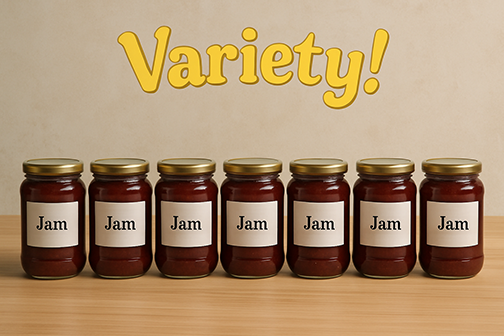
* Image Prompt: Create a photo realistic image. Hovering above the image in cheerful font is the word “Variety!” On a table below are a group of seven identical jam jars, each with a white label that has only the word “Jam” on it in black font.
Leave a Reply