A terrific NYT article explored a new genre of big books emerging from online fan fiction and missed a few things along the way.
On Wednesday, August 20, The New York Times ($) ran a fascinating article: “Why Magic, Dragons and Explicit Sex Are in Bookstores Everywhere: Romantasy is propping up the fiction market. Thanks to a generation that grew up reading about a boy wizard” by Alexandra Alter.
“Romantasy” is “romance plus fantasy,” which you’ll have noticed if you’ve been to a bookstore lately. Along with #BookTok, it’s a driver of who reads what. So much for Oprah and Reese.
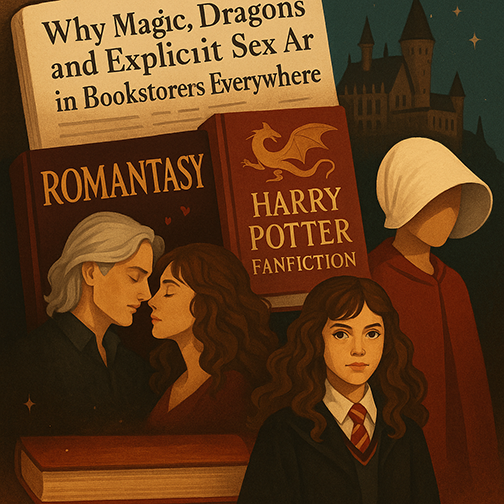
Alter’s topic is Harry Potter fan fiction—particularly “fanfic” where villainous Draco Malfoy and heroic Hermione Granger are in a complex relationship, coded “Dramione”—where some stories have been so successful that they emerged from the gift economy of fanfic and secured big publication deals.
Fanfic is so vast and various that I will only point to Archive of Our Own (AO3), where one can find a dizzying cornucopia of new stories and recombinations featuring beloved characters and plot lines that range from the innocent to the startlingly dark and violent. If you want to avoid, for example, expanding your notion of what two Muppets might do to each other in their spare time, then pay careful attention to the warnings list posted in front of each piece.
Although Alter talks about several different Dramione fanfics that have transmogrified into novels from traditional publishers (“real books” she writes with a slight sneer), she focuses on Manacled by SenLinYu, which at more than 370,000 words is longer than the longest of the original Harry Potter books.
Manacled proved so popular as fanfic that Del Rey Books (part of Penguin Random House) bought the rights for a revised, de-Potterized version called Alchemised, ordered 750,000 copies (meaning the publisher thinks it will be a monster hit), and will release it September 23rd:
As more writers cross over from the shadow world of fanfiction into traditional publishing, the lingering stigma and fear of lawsuits has faded. Entrepreneurial writers realized they could adapt and sell fanfiction without violating copyright law if they changed character names and other derivative material.
This is where things start to get interesting when thinking about Manacled as part of broader Experience Stacks.
Brief Digression: What Is An “Experience Stack”?
An Experience Stack is the customer-facing counterpart to a company’s Tech Stack. A Tech Stack is the combo-platter of software and hardware that a company uses to create, manage, and track its products. An Experience Stack is the non-linear combo-platter of all the activities customers do over time with and around the things companies make. Customers improvisationally shift from context to context during any given experience. That’s all you need to know to understand this piece, but the curious can find my other essays about Experience Stacks here. End of digression.
SenLinYu’s readers will divide into four rough groups, which I’ll describe in order from simplest Experience Stack to most complex:
1. General readers who aren’t big romantasy fans, don’t know about Harry Potter, but who will read Alchemised if it’s a bestseller.
2. Romantasy readers who are not Harry Potter knowledgeable (perhaps having declined to read J.K. Rowling’s originals because of her views about trans people), and who will compare Alchemised to other romantasy books.
3. Harry Potter fans who don’t know about or have never read fanfic, don’t know about Manacled, but upon reading Alchemised realize the similarities between Alchemised and Harry Potter and make the comparisons.
4. Harry Potter fans who know about fanfic, know that Alchemised started as Manacled, and who will make both the Alchemised/Manacled comparisons and the Alchemised/Manacled/Harry Potter comparisons.
It shouldn’t amaze me—but it still does amaze me—that people in the first two categories exist.
I have a vivid memory of buying a first edition hardback of Harry Potter and the Sorcerer’s Stone at Black Oak Books (R.I.P.) in Berkeley, California in 1998. I bought and still have first editions of all the other books, have seen all the movies, visited the Harry Potter part of Universal Studios in Los Angeles and the Harry Potter Studio Tour in London. My kids grew up on Harry Potter books and movies. I don’t agree with Rowling’s weird opinions about trans people, but I don’t find coded anti-trans messaging in the Harry Potter series, so I don’t reject the art even though I disagree with the artist. (I’ve written about the great artist/bad person problem here.)
Translation: I have a towering Harry Potter Experience Stack.
In contrast, Sen, as they are called, grew up in a conservative Christian family that forbade the Harry Potter books, but Sen found Harry Potter fanfic online as a kid. They didn’t read the originals until college, but they read a prodigious amount of Harry Potter fanfic, which means that their Harry Potter Experience Stack is at least as tall as mine but vastly different.
Is Manacled Good? Yes, and…
SenLinYu deleted Manacled from AO3 when they started revising, but it’s still readily available on The Internet Archive, so I downloaded it to my Kindle app. It’s compelling but long—so, so long. I’m 25% through. I think I’ll keep reading, but maybe not because there are many rape scenes. The two main characters are recognizably Hermione and Draco.
But the plot isn’t Harry Potter at all: it’s Margaret Atwood’s The Handmaid’s Tale. I taught The Handmaid’s Tale at Berkeley, so I know the book well (I haven’t the stomach for the Hulu series).
In Manacled, the setting is post-war. The magical good guys have lost, and for undisclosed reasons human fertility among the Wizarding folk has almost vanished. Fertile witches are in short supply, so the government assigns fertile witches like Hermione to leaders of Voldemort’s Death Eaters to impregnate, one of whom is Draco. When in public, the fertile witches are forced to wear large robes and bizarre bonnets that block their peripheral vision.
The Death Eaters don’t rename Hermione Ofdraco, but aside from that Manacled is more Atwood than Rowling. (Alter missed this, but other online writers have noticed.)
This complicated my Experience Stack even more than the Group #4 I described above—in a good way. That realization made me feel smart, expert, which is a good way to bond your reader to your work or your customer to your product.
Will I read Alchemised when it comes out? Maybe. I’m curious, but will it be as interesting stripped of its Potter fanfic context?
Del Rey Books is betting on it.
Note: to get articles like this one—plus a lot more—in your inbox, please subscribe to my free weekly newsletter.
* Image Prompts: My first prompt, “Please create an image that captures the essence of this essay,” resulted in this…
…which was too on the nose. I then asked, “Please try again but don’t include the title of the article and give a hint about The Handmaid’s Tale bit at the end.” That yielded the image that’s at the start of this week’s main story.
Leave a Reply