There’s a difference between making “good enough” decisions and always trying to make the best decision, which is exhausting.
This article is the fifth in my keywords thread, but you don’t need to read anything else to understand this one.
Barry Schwartz, author of the useful book The Paradox of Choice, recently appeared on The Happiness Lab podcast to talk about his new, co-authored book, Choose Wisely, which I ordered on the spot. Schwartz is one of the best-living thinkers about the distinction between two kinds of people: satisficers and maximizers. Twentieth Century polymath Herbert Simon coined the ungainly term “satisficer,” which is a variant on satisfaction. The Latin roots of satisfaction—satis plus facere—mean to be made enough.
When The Rolling Stones sing, “I can’t get no satisfaction” it means “nothing will ever be enough.” Without the double negative, the meaning is a more clear in “Satisfied” from Hamilton: “he will never be satisfied.” When Ken wears a “Kenough” t-shirt in Barbie, he’s trying to abandon his need for external validation as Barbie’s accessory, to be enough as “Just Ken.”
Maximizers want to make the best possible choice. Satisficers want to make a choice that’s good enough. One of Schwartz’s points in Paradox of Choice is that satisficers tend to be happier than maximizers because they preserve mental energy by not wasting it on trivial choices.
We often talk about attention, mental energy, as a currency: we pay attention. Another metaphor talks about attention as light, distinguishing between spotlight attention, when we concentrate on a specific thing, and lantern attention, when our awareness is more ambient. Combining these metaphors, we might think about things that capture our ambient awareness and provoke us to turn our spotlights as attentional taxes, steep ones.
People maximize about different things. Advertisers tend to treat every potential customer as a maximizer even though often just want to satisfice and be done with a decision about, say, detergent.
A photographer who wants to get better might invest money in best-quality equipment and special classes. I’m not that kind of person, so I use my iPhone to take pictures (they’re good and getting better with each new device).
I am picky about pens. I have a variety of cheap but specific Japanese pens on my desk and in my bag at all times—different colors, thicknesses of line, and shapes—because I have a system for taking notes. I also have fountain pens and inks for when I need to concentrate and slow down. Some folks are picky about paper. I am, but not because it has to be high quality. I need to be able to scan things into Evernote, so the pages need to be individual or perforated.
How satisficing can increase happiness
When I’m mentoring younger people, I often advise them to have vague goals. I don’t mean they should have no goals or flabby goals. Instead, they should have goals with wiggle room, goals that will enable them to satisfice rather than try to maximize and fail.
College is a great example of where satisficing gives you better odds at happiness than maximizing. If you only want to go to Yale, and only apply to other schools out of fear, then you are a maximizer about Yale. The problem? No matter how qualified you are, the odds are 95.4% against you. If, instead, you interrogate the reasons why you want to go to Yale (high quality faculty with low class sizes, prestige, a new geography that’s far from home) then you’ll find other schools. Your odds go up, and you’re less likely to be disappointed. Another applicant might maximize around cost (Yale is expensive) and satisfice about geography.
Satisficing is one of my keywords because it’s a useful tool when approaching any decision. “How much do you care about the specific shape of this outcome?” (Which is different than “What is the Dream Outcome.”)
Satisficing can also make better collaborators: people on a team will maximize about different aspects of a project and satisfice about the rest, then negotiate. When it works, projects get better.
If you know when you’re satisficing and when you’re maximizing, it can also give you a better handle on (be patient) contingency after the fact. What I mean: after an event has occurred, it’s easy to look back and think that the outcome that did happen was meant to be because, y’know, it happened. It’s easy to forget that something else could have happened when you maximized successfully.
Thinking that something was meant to be erases your own agency in what happened as well as the agency of others. This sets you up to be disappointed later when a situation calls for you to do something, and you trust that the outcome you want will happen without exerting yourself.
How much mental energy can satisficing really save?
Although satisficing is a good tool for helping conserve your mental energy, it’s not a great tool because there are too many things out there shrieking for your attention every waking moment.
Psychologists talk about decision fatigue. (I’ve written before about Daniel J. Levitin’s idea that we each have a finite amount of daily decision-making energy, after which we make crappy decisions.) Lately, I’ve been thinking that “fatigue” is not strong enough. It suggests that we can sleep on it and wake up to make better decisions.
What “fatigue” fails to capture is that there are a lot more things asking us to make decisions or ignore than ever before. The internet and social media and creator platforms were just the start. Now, with AI creating evermore writing, pictures, videos, and more, the jackpot of things we need to decide keeps building.
“Decision exhaustion” comes to mind. So does “decision bankruptcy,” but the latter is misleading because you can declare financial bankruptcy but not decision bankruptcy.
I suspect, but have no data to support, that our need to satisfice in order to manage the tsunami of information hitting us moment-to-moment has played a part in our political polarization. It takes decisional energy to think, “wait, is this true?” That energy is in short supply that keeps getting shorter.
Note: to get articles like this one, plus a lot more, in your inbox, please subscribe to my free weekly newsletter: The Brad Berens Weekly Dispatch.
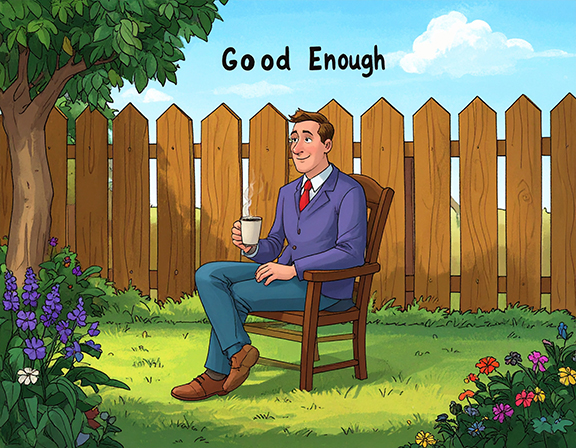
* Image Prompt: Morning. A man sitting on a chair in a very small garden with an imposing wood fence behind him. The man is holding a cup of coffee. Above the man’s head float the words “Good Enough”.
Leave a Reply