Recent political events resemble a moment from “King Henry IV, Part Two.”
I am an apex nerd. My passions include science fiction, comic books, fountain pens (a fresh rabbit hole into which I’ve faaaaallen) and comedy. As a researcher, I examine how our behavior changes, and doesn’t change, in the face of new technologies, most recently AI.
Just ask my kids: I am an omnidirectional geek.
The most fathomless of my nerderies, the one to which I’ve devoted the most, is Shakespeare. His works are never far from my mind.
It is, therefore, unsurprising that the Trump administration’s recent attack on Venezuela and capture of Nicholas Maduro, plus the revived rhetoric about annexing Greenland, would pluck a chord from Shakespeare’s history plays, specifically a moment from near the end of Henry IV, Part Two.
(Note: if you want to avoid any political discussion and skip the rest of this Dispatch, I won’t blame you. However, despite my differences with the president, this is not an attack on the attack; it’s an analysis of a strategy and an analogy.)
For those readers who don’t have medieval British history at the front of their minds, Henry the Fourth seized the throne from a very unpopular Richard the Second and later had Richard executed. Civil war then consumed the whole of Henry’s reign. Shakespeare told the story of these events across the first three of his second quartet of history plays: Richard II, Henry IV, Part One and Part Two.
In Act Five of Henry IV, Part Two, as the king lies dying, he counsels his son—Prince Hal, soon to be King Henry the Fifth—about how to legitimize his claim to the throne. To distract his enemies, the King had decided on a crusade to Jerusalem:
     To lead out many to the Holy Land,
     Lest rest and lying still might make them look
     Too near unto my state.
But his health failed him, and now he tells Hal:
                           Therefore, my Harry,
     Be it thy course to busy giddy minds
     With foreign quarrels, that action hence borne out
     May waste the memory of the former days.
King Henry the Fifth, in the next play (which bears his name) goes on to follow his father’s advice. However, instead of a crusade to the Holy Land, the young king sets his gaze on a closer target: France and his claim to that throne.
After three plays about English civil war, in Henry the Fifth, Shakespeare turns to unification, a country focused on conquering France—sloughing off its internal conflicts. Although the full text of Henry the Fifth shows an even-handed treatment of war, over its history many productions have turned the play into a jingoistic, patriotic anthem, perhaps most famously in Laurence Olivier’s 1944 movie made during WWII. (You can watch it free with ads on The Roku Channel or without ads if you subscribe to HBO Max.)
Most scholars date the play to 1599, just a handful of years before Queen Elizabeth died in 1603. Since Elizabeth was old (66), childless, and declined to name an heir, who would succeed her was an open and vexing question. The themes running through the second set of Shakespeare’s history plays were not far from what was happening politically in the world outside the Globe Theater, although the medieval setting would have protected him from charges of outright political commentary. (His friend Ben Johnson got into hot water repeatedly for being less careful.)
Busy giddy minds with foreign quarrels
Here, “busy” is a transitive verb. The phrase and what follows translate into duller language as “Distract the distractible with problems far away from our shores so that conflict, drawn to its conclusion, will erode the memory of problems here at home.”
If you follow the analogy, this is what the Trump Administration is doing with its attack on Venezuela, capture of Maduro, throat clearing about Greenland, and threats to attack Iran if the regime kills protesters. It’s always easier for a wartime president to increase the power of the executive branch, which is one reason why the administration is trying to change the name of the Defense Department to the Department of War. Pete Hegseth uses the title Secretary of War currently, although Congress would have to pass legislation to make it official.
Although the foreign military engagements are real and dangerous, the strategy behind them is to distract the distractible from the conflicts happening here at home: ICE killing people in Minnesota, reduction of SNAP benefits, reduced abortion access, high prices at the grocery store, rising health care costs, declining employment… and on and on.
This strategy is new and distinct from Steve Bannon’s “flood the zone with shit” strategy, which overwhelmed the media and the public with outrageous but often inconsequential stories. The stakes of the new strategy are higher, much higher.
How giddy are our minds?
Note: to get articles like this one, plus a whole lot more, in your inbox, please subscribe to my free weekly newsletter.
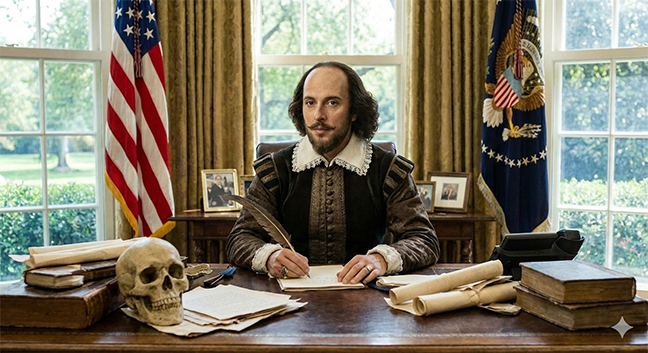
* Image Prompt: “Please create a photorealistic image of William Shakespeare sitting behind the Resolute Desk at the White House.” Gemini’s first result was too far away, so I asked it to move closer, which it did. This was the best of the images different AIs created, and the only one that thoughtfully added the skull from Hamlet and wrapped up roles. They all had quills.
Leave a Reply