How can we escape closed-loop thinking? (Hint: it’s not logic.)
La Profesora turned me onto a recent episode of Your Undivided Attention, a podcast by Tristan Harris and Aza Raskin of The Center for Humane Technology. In “What Would It Take to Actually Trust Each Other? The Game Theory Dilemma,” Harris and Raskin talk with Professor Sonja Amadae of the University of Helsinki. She is the author of Prisoners of Reason: Game Theory and Neoliberal Political Economy, about the limitations of game theory. The three also discuss how the rise of AI is making these limitations more urgent.
The episode is 45 minutes of thoughtful, chocolatey goodness, and I recommend listening to the whole thing. Briefly, though, the three explore how classic game theory has infected political, social, and business thinking to the overall detriment of a happy society. Amadae traces this to John von Neumann and Oskar Morgenstern’s WWII-era notion of “expected utility” being the only worthy metric for any endeavor.
One fascinating part of the discussion orbited the inescapability of game theory: if you think within a game theory framework, then you wind up presuming that everybody else is doing the same thing—a selfish, Sartre-esque closed loop where you can never trust another person and believe that they can never trust you.
I’m suspicious of closed loops and intellectual no-escape rooms. The most frustrating is Freudian theory: if you balk at anything Freud postulated, then a Freudian will diagnose you with a Freudian malady. “Ah,” the Freudian will nod, “you’re in an Oedipal conflict with Freud.” At that point, I run away before I start swearing.
Another closed loop is Milton Friedman’s notion of “increased shareholder value” being the only metric that matters for public companies, which reduces every other consideration (morality, duty to one’s employees, community, the environment) either to irrelevance or to maybe-surmountable obstacles. Yet another is the quip most people attribute to Peter Drucker: “what gets measured gets managed,” which ignores the unmeasurable even though that is probably where you’ll find your organization or product’s unique strength.
Michael J. Sandel’s brilliant book, What Money Can’t Buy: The Moral Limits of Markets, explores how adding price tags to priceless things changes behavior and erodes community. “Altruism, generosity, solidarity, and civic spirit are not like commodities that are depleted with use. They are more like muscles that develop and grow stronger with exercise” (130).
The pressing question is how to escape from market norms, game theory, Freudian logic, and the like.
This is hard because after a leap of faith—that moment when you move from one type of thinking to another—the first type often evaporates from your memory. (I explored something similar in “Adapt-amnesia and Why It Matters.”)
When you first learn to drive a car, for example, driving is an alarming collection of different actions: now I’m signaling, now I’m turning the steering wheel, now I’m pressing down on the accelerator, whoops! now I’m slamming on the brakes. After you’ve been doing this for a while, you leap from a collection of actions to one fluid activity: I’m driving.
Psychologists call this leap a transition from data-driven mental processing to schema-driven mental processing. The collection of actions fuses into a single schema: driving. Once you know how to drive, once you have that schema, you can drive yourself to work in the morning and have no idea which route you took because you’ve used your data-driven processing on other things.
It is hard, perhaps impossible, to describe that leap, but we still know we jumped. The great twentieth century polymath Michael Polanyi called this “tacit knowledge.” I can recognize my friend Myles across the room at a CES party, but ask me how I recognized him, and I’ll be hard pressed to explain.
We can’t logic our way into a new way of thinking when the new way can neither be contained nor expressed by the old way’s presumptions.
Here’s how Polanyi described this “you can’t get there from here” phenomenon in his 1966 book, The Tacit Dimension (warning: this gets heady for a moment, but I’ll be right back)…
The operations of a higher level cannot be accounted for by the laws governing its particulars forming the lower level. You cannot derive a vocabulary from phonetics; you cannot derive the grammar of a language from its vocabulary; a correct use of grammar does not account for good style; and a good style does not provide the content of a piece of prose. We may conclude then quite generally… that it is impossible to represent the organizing principles of a higher level by the laws governing its isolated particulars. (36)
Closed loops thinkers are worse than cynical and skeptical: they are delusional. They don’t just think that it’s unlikely that you can get from where you are to where you aren’t by a leap of faith. They deny that there is any place to land after you leap. This is a universe of zero-sum games where for me to win you must lose.
Sound familiar? To me, it sounds like the thesis for the present political moment.
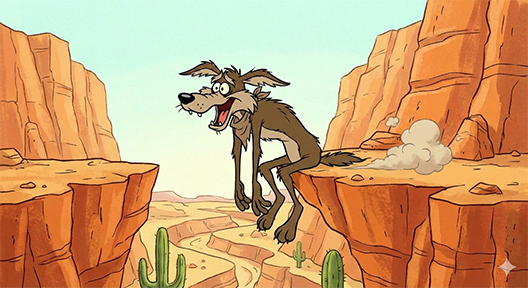
I prefer hope. I’ll risk falling like the Coyote in the Road Runner cartoons. At least it’s better than being stuck in a world where the best thing you can do is presume the worst of others.
For the past 15 or so years, I’ve been arguing that everything that can be digitized will be digitized, so you should focus your attention on the things that cannot be digitized. Now, AI is pushing what is digitizable even further, which means we have to lean into the exploration of what is uniquely human.
Like leaps of faith.
* Image Prompt: Please create an image of a cartoon coyote (that looks like but is not the same as Wile E. Coyote Road Runner cartoons) successfully leaping from one desert cliff to another without falling. He lands with a huge expression of relief.
Works Cited
Amadae, Sonja. Prisoners of Reason: Game Theory and Neoliberal Political Economy. New York: Cambridge University Press, 2015.
Berens, Brad. Adapt-amnesia and Why It Matters. From The Brad Berens Weekly Dispatch. April 13, 2025.
Harris, Tristan and Aza Raskin: “What Would It Take to Actually Trust Each Other? The Game Theory Dilemma,” in Your Undivided Attention. Podcast, January 8, 2026.
Polanyi, Michael. The Tacit Dimension. Chicago: The University of Chicago Press, 1966.
Sandel, Michael J. ‘s What Money Can’t Buy: the Moral Limits of Markets. New York: FS&G, 2012.
Note: if you’d like to receive articles like this one, plus a lot more, then please subscribe to my free weekly newsletter!
Leave a Reply