What kind of thinker are you? Knowing the difference between when you’re a hedgehog & when you’re a fox can be empowering.
The following piece is part of a “Keywords” series that I’ve slowly built over the history of The Dispatch.
Before we start, though, I want to share that Claude was helpful developing my argument in a startling way. I wrote every word, but when I asked Claude to look at my initial set of hedgehog and fox pairings, it came up with others, chastised me for oversimplifying the Isaiah Berlin argument at the beginning of the piece, and pushed me to think differently. I’ve hung a PDF of our conversation here for the curious.
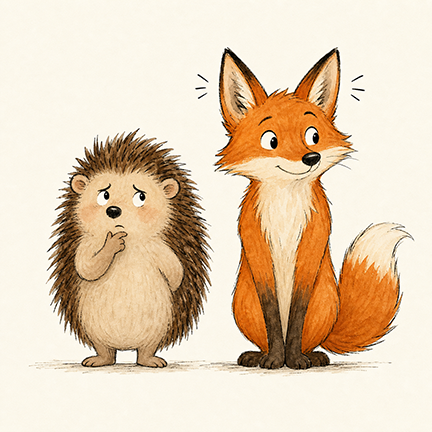
When thinking about different thinkers—particularly in meetings where different cognitive styles bump against each other—a useful mental experiment is to divide people into hedgehogs and foxes. Hedgehogs know one thing very well. Foxes know many things, but not as well as the hedgehog knows its one thing.
In any meeting, when I hear somebody speaking from a perspective constrained by his or her area of expertise and accountability, I think quietly to myself, “ah, hedgehog.” Likewise, possibly in that same meeting, when somebody else skips over pesky details that might derail a shiny idea, I think, “fox.”
Each of us is a hedgehog about some things and a fox about others. The distinction is about a role within a situation rather than a generalization about somebody’s entire identity.
It’s an ancient idea, but the best articulation of it in my experience comes from Isaiah Berlin’s famous (among literary circles, I admit) 1953 book, The Hedgehog and the Foxabout the Russian novelist Tolstoy.
Berlin opens his book in a high academic patois…
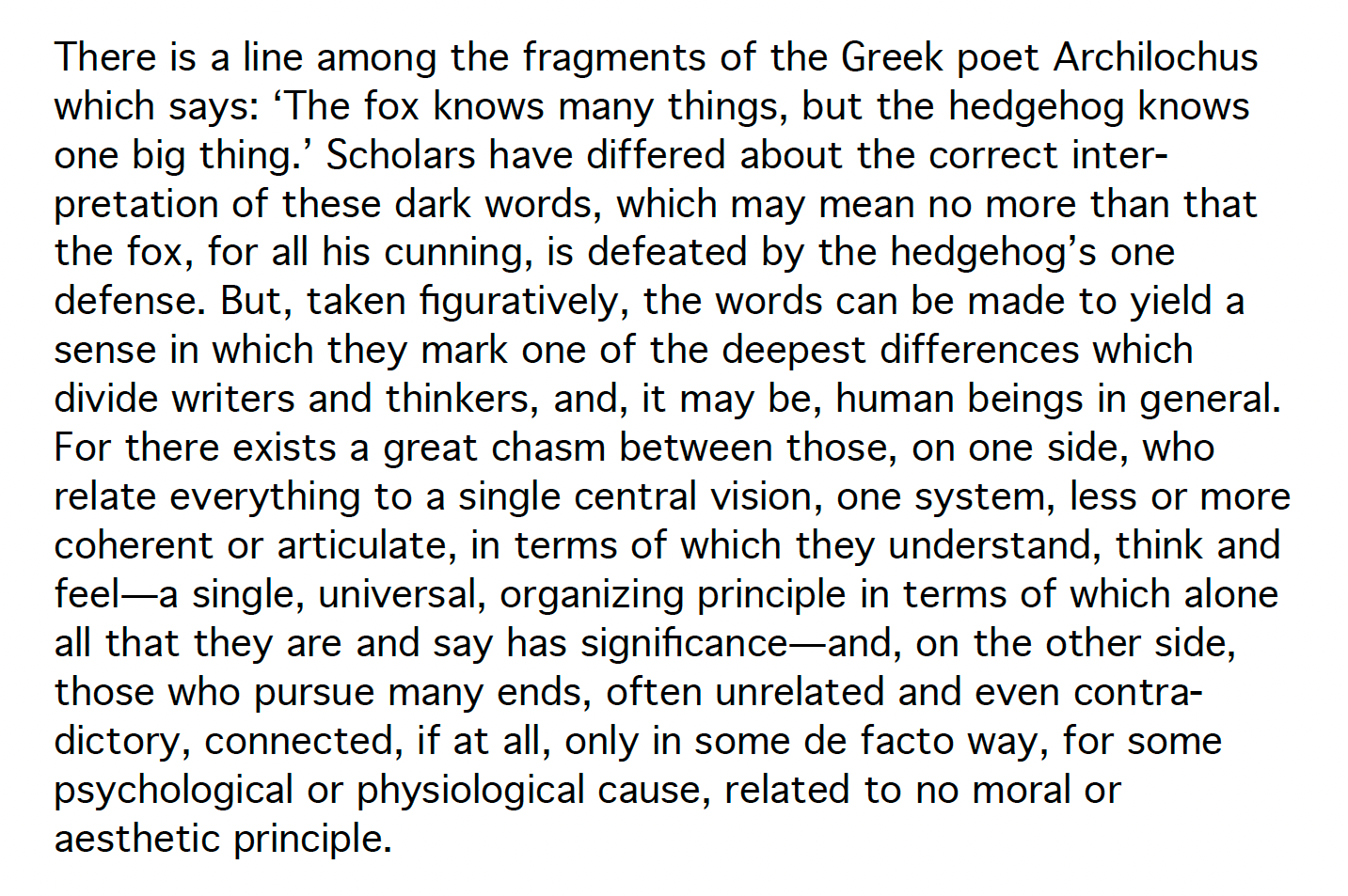
There are similar ways of thinking about these different sorts of thinking that help explain Berlin’s distinction. For example, Berkeley psychology professor Alison Gopnik distinguishes between spotlight attention (hedgehog) that focuses on one thing and ambient lantern attention (fox) that is aware of many surrounding things.
Despite being, as La Profesora (lovingly) describes me, “an apex nerd,” I’m more fox than hedgehog. If you look at one of my abiding interests by itself, then I seem to have quills. However, when you look at my interests in toto (Shakespeare, comic books, science fiction, fountain pens, how behavior changes in the face of technology, strategy, psychology, business, marketing), then I seem to have pointy ears and a bushy tail.
It depends on the situation.
Here are modern day examples of hedgehogs and foxes:
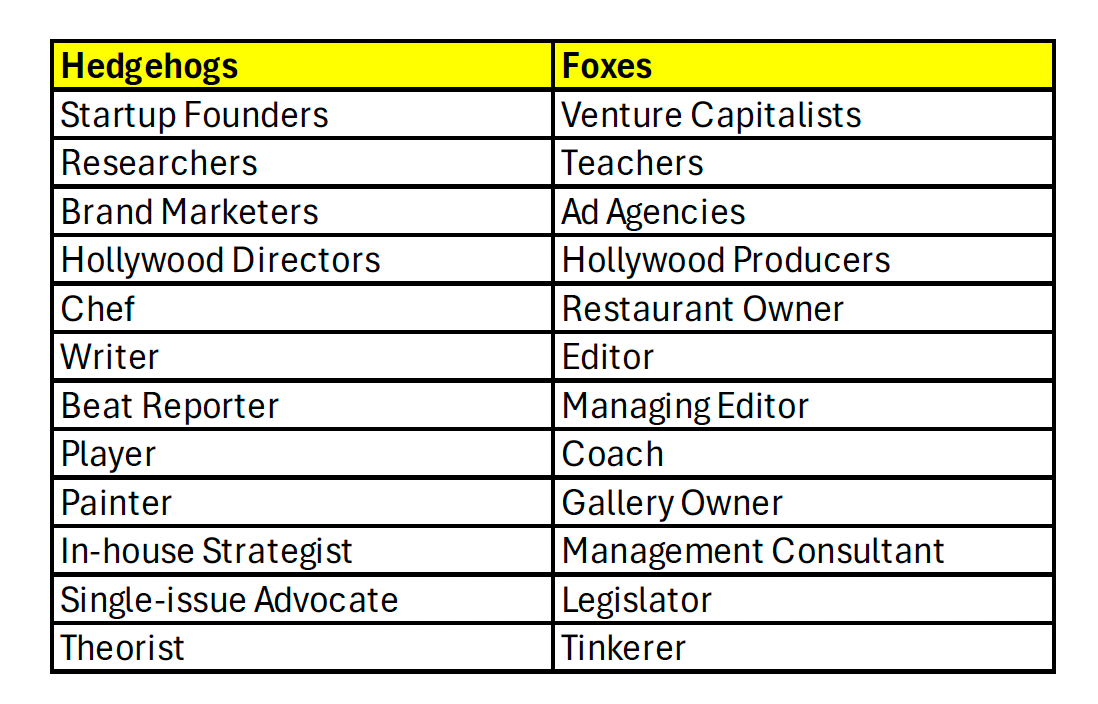
The pairs bring to life the situational quality of the hedgehog and fox distinction, and how when the situation changes so does the orientation. A startup founder deep into her first idea about her company is a hedgehog, but a startup founder who pivots when she realizes that success lies in a different direction becomes a fox.
When a professor is working on a big study or a Sherlock Holmesian “trifling monograph,” focused on turning research into results, she is a hedgehog. When that same person is teaching a class—improvisationally helping students to understand ranging materials through comparison, analysis, and insight—she is a fox.
Applying Berlin’s distinction to organizations reveals something important: hedgehogs and foxes often need each other. Most startup founders can’t scale their businesses without investors. Investors need things in which to invest. This can even be the case within an individual: many professors teach in order to support their research, and they might hire their promising students to help in the lab.
All organizations from a married couple to a massive multinational corporation need both hedgehogs and foxes. The myth of the superhumanly prolific scientist alone in her lab, the artist alone in his garret, belies the reality that the successful solo-practitioner has a lot of other people providing support. True hermits tend not to become huge successes.
Coda: Hedgehogs and Foxes in the Age of AI
In the first draft of this piece, I was ending with a debate about whether AIs are hedgehogs or foxes. I thought they looked like foxes but were actually hedgehogs.
Ironically, it was a further conversation with Claude that helped me to realize I was thinking about AIs as if they are thinkers rather than tools. This is the slippery slope that has prompted disturbed teens to kill themselves after long dialogues with AIs and provoked whackadoodle behavior like people marrying their AIs, not to mention the myriad stories when people simply didn’t check whether an AI was hallucinating and suffered consequences.
Instead of an answer I’m left with questions to ponder: when a hedgehog has access to a thought partner like Claude, does that make the hedgehog more hedgehog-like or—with always-on access to a different point of view—more foxy?
Likewise, will a fox with Claude become even more of an improvisational tinkerer, or will the fox, in the process of query after query, become more likely to develop a hedgehoggy single principle as a lens through which to view the world because the tool keeps connecting things in plausible but not necessarily useful ways?
Will different thinkers find it easier to communicate with each other? Harder? Qualitatively different rather than in degree?
Like every other question about how AI is changing the world, the answer is “I don’t know, and that worries me.”
Note: To get articles like this one, plus many more goodies and things worth your attention, subscribe to my free newsletter: The Brad Berens Weekly Dispatch.
* Image Prompt: “Please create a square image in a children’s book illustration style similar to that of Mo Willems in his Elephant and Piggie books. In this case, a hedgehog and a fox stand side by side, both facing the viewer. The hedgehog is holding its chin in its hand, deep in thought. The fox, in contrast, pays attention to the world around it, eyes looking, ears listening.” ChatGPT told me that it couldn’t imitate Willems’ style, but that it would create something close. It succeeded, although the Disney people might not be thrilled.
Leave a Reply