Douglas Belkin and Josh Ulick wrote an important piece in WSJ ($) this week: America’s Colleges Are Hurtling Toward an Enrollment Cliff. The subtitle makes the stakes more apparent: “Will the ‘demographic cliff’—the declining population of 18-year-olds—ease the brutal process? Depends where you go.”
Overall, college enrollments are forecast to drop 13% over the next 15 years due to demographic changes and the ongoing pressure on the economic value of a college education. Prestigious colleges and universities will be fine. The article demonstrates this with charts of college acceptance rates over the last 20 years, where more desirable schools have declining rates and less desirable schools have increasing ones.
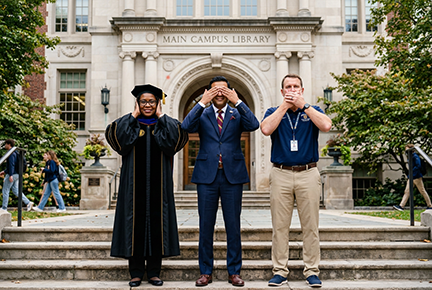
My take? This development has a similar shape to other parts of the economy—like the movie business where the bulk of profit goes to the top 20% of movies each year.
It also signals that the traditional four-year bundle of classes is falling apart. We can see a prior, devastating example of bundle decay in the music business. Record labels forced us to buy a dozen songs on vinyl, cassette, or CD instead of the one song we wanted… until Napster, iTunes, and then Spotify came along. (See Higher Education’s “Napster Moment”.)
Even though most colleges and universities are nonprofits, their economic models still focus on growth. Grow the endowment. Grow the number of grants. Grow the number of applications. Increase tuition prices. Build a new lab, a new library, a new stadium. Ask the alumni for more, more, more.
Oh, and give the professors less, less, less. The administrations can get away with that because there are always a ton of unemployed Ph.D.s wandering around. Why? For decades universities have admitted more graduate students than the academic job market could support because somebody has to teach those pesky freshman classes and labs. (See Will Teach for Food: a Mini-Memoir.)
The top 20% of colleges and universities will benefit, not suffer.
The other 80% should be panicking about an overall declining population of 18 year olds and, even worse, a further, steeper decline within that population: fewer and fewer kids think that going to college has a good ROI. (As La Profesora pointed when we chatted about this, the Trump administration’s attacks on funding for universities, intellectual freedom, and general anti-intellectual stance exacerbate this.)
Colleges and universities should be looking for new economic models, but I doubt they will because the incentives for administrators still center on growth. As Charlie Munger observed, “show me the incentive and I will show you the outcome.”
What might a new economic model look like? A focus on efficiency instead of growth to start.
Campuses near each other might specialize and federate.
Instead of going to one college, an interested student would apply to a system of campuses in a town, city, or region.
Let’s suppose that a moderately-sized city has a state university, a community college, a Catholic college, and a liberal arts college. One campus might focus on humanities. One on computer science. One on physical sciences. One on nursing. With specialization and federation there would be one Spanish program instead of four, one Psych 101, one writing program, one freshman chemistry lab—each built to be best in class.
On the research side, four campuses combined might evolve over time into a top-flight research organization (R1), which would benefit everybody (faculty, students, administrators).
Students could take classes across all campuses in a frictionless way.
Transportation from campus to campus would become a priority, with specialized tunnels (like what the HyperLoop wanted to be) or light rail making it easy to hop from class to class. One big and fabulous gym could serve everybody in the system.
New and improved facilities: when needed, all the campuses in a college system could pool resources to create shared classrooms that could shift from one college to another with the press of a button: the educational equivalent of dark kitchens. This would be a particular benefit for online or hybrid online/offline classes.
Downsides: this would be brutal for both present untenured faculty and people who want to become university teachers, since combining departments would slash jobs. But there is no quick fix for the decades-long overproduction of doctorates. Only more decades of right-sizing can help that.
The first step? Rewrite administration incentives away from growth, away from more, to focus on better.
Most important.
If none of this significantly lowers the cost of college for students, it’s not worth doing. The weakest campuses should fail. As I’ve written before, between 1980 and 2025, the cost of higher education increased by 1,249.85% at a rate nearly twice the general inflation rate. That is obscene.
A college education should set up a young person with skills, experiences, and cognitive tools to make them more capable citizens and employees. The degree shouldreward the sacrifice of four years of earnings with increased earning potential over the subsequent decades.
It should not hang an anvil of debt around a young person’s neck. It should not make her spend decades digging out while worrying that—even with that college degree—she still might wind up making soy milk lattes. The latter is too often the case.
The system is broken. Will any college in the lower 80% pivot in time? I doubt it, but I’m not hopeless. What do you think?
Note: To get images like this one, plus a lot more goodies and things worth your attention, please subscribe to my free weekly newsletter, The Dispatch!
* Image Prompt: “A photorealistic , 6w x 4h image of three people: a female professor in full academic regalia, a university administrator in an expensive suit, and a college football coach. Vary the genders and races. The three people should imitate the “hear no evil, see no evil, speak no evil” classic image. Make sure to have 15% left and right background space so that the image can post without being cut off. The background is the front of the main campus library.” Adobe Firefly got it on the second try when I asked it to Zoom in 15%.
Leave a Reply