From Star Trek to Shakespeare, different kinds of reference create different experiences for fans.
The final two episodes of the just-completed fourth season of Star Trek: Strange New Worlds (SNW, on Paramount+) each contained exercises in extra levels of experience for fans, but they were of different flavors.
In the season finale, “Tomorrow’s Enterprise”…
Lieutenant Uhura (Celia Rose Gooding) has to work with a one-year-in-the-future version of herself to resolve a time-travel paradox to save the life of Engineer Montgomery “Scotty” Scott (Martin Quinn).
For casual viewers of the 1960s original series (TOS), the extra experience is that the future Uhura works on the Enterprise of James Kirk (Paul Wesley), whereas the usual SNW Uhura works on the Enterprise of Christopher Pike (Anson Mount). The future Uhura wears the iconic hairstyle that Nichelle Nichols wore in the 1960s, and there are other echoes from that first series.
For more serious Trek-fans, the title is an allusion to a 1990 episode from Season 3 of Star Trek: The Next Generation (TNG), “Yesterday’s Enterprise.” This, too, is a time travel story in which the Enterprise C gets displaced in time to a future where the Enterprise D is on its ongoing exploratory mission. The C’s displacement causes a change to the timeline where the D-era’s Federation is at war with the Klingons. Tasha Yar (Denise Crosby), a character who had died late in Season 1, pops back to life in this changed timeline, later sacrificing herself to restore the original timeline by returning to the past with the C. (You can’t complain about a spoiler: it’s been 36 years.)
Both references—to the haircut from the 1960s and the episode of the 1990s—are thoughtful but relatively common amplifying fan references. They create a frisson of recognition for the fans who understand them, but for the viewers who don’t catch the references, nothing inhibits their ability to understand and enjoy the episode.
The early Marvel movies had a lot of this sort of reference. For example, Captain America’s shield, or a prototype of it, was in the background of Tony Stark’s lab in both Iron Man and Iron Man 2. As the MCU got more complex, each movie got harder to understand unless you had seen the others. (I wrote about that here.) The most recent Spider-Man movie (Brand New Day) was refreshing in that a viewer didn’t need to have completed a college survey course in Marvel movies to enjoy it.
The second-to-last episode of SNW, “Once La’an a Time”…
Has a different kind of allusion. The episode is complex and silly, involving doppelgängers in a fantasy world, that gave cast members the chance to show their comic chops.
Near the end, after the climax of the fantasy story, La’an Noonien Singh (Christina Chong) chats with Pike and Dr. M’Benga (Babs Olusanmokun):
SINGH. Sir, what will become of the planet and its people?
PIKE. Well for starters, it’s not a planet. It’s a ship. Pelia’s staying behind to study its engineering and pilot it home. At least, that’s what she told us.
M’BENGA. Apparently, she hooked up with the queen’s cook. Max.
For the knowing viewer, this extraneous detail about the name of Pelia’s new paramour is a reference to the 1987 movie The Princess Bride. In that movie, actor Carol Kane, who plays Chief Engineer Pelia in SNW, played Valerie, the wife of Miracle Max (Billy Crystal), the wizard who restores Westley (Cary Elwes) to life in time to save the day.** Crystal and Kane only appear in one scene in the movie. The makeup for Valerie back in 1987 made Kane look a great deal older. 41 years later, Kane is older in reality, and looks more like Valerie (although not nearly as crone-ified).
The reason this is a different flavor of allusion is that it’s to an actor, not to a character or plot detail. Only viewers who a) have seen The Princess Bride, b) have seen SNW, and c) recognize Carol Kane as an actor in both would field this reference.
It’s not a random reference, but it’s a reference that no amount of attentive watching of 60 years of Star Trek stories could ever prepare a viewer to understand.
As it happens, I wrote my doctoral thesis about just this sort of reference, only the references happened in Shakespeare’s original company of players in the late 1500s and early 1600s. Back then, I referred to this phenomenon as “repertory allusion,” and argued that a web of inter-play references that have to do with actors’ bodies rather than plots is a part of what has caused Shakespeare to stay relevant more than four centuries later.
If you ever want to get me going, just ask about the complex relationship between Much Ado About Nothing and Romeo and Juliet.
Note: To get articles like this one in your inbox, plus a lot more goodies and things worth your attention, please subscribe to my free weekly newsletter!
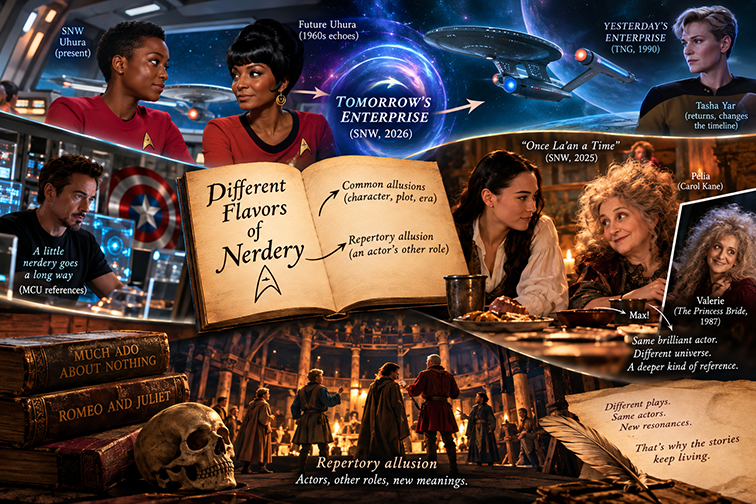
* Image Prompt: “Please create an image that reflects the ideas and sentiments in this short essay.” Holy moly! I did not expect ChatGPT to create something with this level of specificity. In the first version, it got the year for the SNW episode wrong. When I asked ChatGPT to fix the year, I expected an entirely different image since chatbot memory is so short, but it fixed the year and made no other changes.
** It is conceivable that what sparked the throwaway reference to Max was the similarity between Westley’s costume in The Princess Bride and Paul Wesley’s costume in the fantasy parts of the SNW episode, as well as the similarity between Wesley and Westley, but even I won’t start digging into that rabbit hole.”
Leave a Reply