How does an early 1990s caper movie help us understand the threat and promise of today’s sharpest-edged AI models?
On April 7th, Anthropic announced that it had created Mythos, an AI so powerful that it can find long-undiscovered software bugs, making banks, hospitals, and other key holders of personal data vulnerable to hackers and scammers. Worried, Anthropic has constrained Mythos access to a few important companies so that they can bolster their cybersecurity either a) before letting more organizations get access, or b) before other AI companies can match Mythos’ capabilities.
The second is a bigger worry: once open-source AI models (like China’s DeepSeek and Meta’s Llama) can do what Mythos does, then bad actors will be able to copy and paste code that sees holes in digital firewalls like leaks in a water balloon. (The April 18th issue of The Economist ($) has insightful coverage and analysis of this.)
The story sounded oddly familiar. It sounded, I realized, like the 1992 caper movie Sneakers where a quirky band of security consultants wind up pursuing a small, experimental, hi-tech box that can unravel any code.
Sneakers is a Retro Future, an older science fiction story that deserves a look back to see how well it predicted where we are now, what it got right, and what it missed.
Before I say anything else, I want you to know that Sneakers is a terrific movie with an amazing cast: Robert Redford, Sidney Poitier, Ben Kingsley, David Strathairn, Dan Ackroyd, River Phoenix, and Mary McDonnell headline, with terrific work by other actors like Timothy Busfield and James Earl Jones. Eddie Jones, whom I’d only seen as the kindly Jonathan Kent in Lois and Clark: the New Adventures of Superman, turns in a chilling performance as a hit man.
Phil Alden Robinson wrote and directed Sneakers. His other films include Field of Dreams and (a personal favorite) All of Me.
You can see the Sneakers trailer here:
The movie will be streamable on Amazon Prime starting May 1st.
What Sneakers Gets Right
What Mythos shows and what Sneakers anticipated is that our secrets ain’t all that secret.
Dr. Gunter Janek, played by Donal Logue, is the mathematician who develops the ultimate decoder box that gives its controllers unfettered access to the Federal Reserve, the national electricity grid, Air Traffic Control, and so on. Digital defenses are made of math, and better math can defeat them.
Anthropic’s Mythos is better math, which puts all our secrets (and we all have something we’d prefer to keep private) at risk of exposure.
What Sneakers Gets Wrong
1992 was roughly a decade before the commercially available internet hit 50% of the U.S. population. It was when services like Prodigy, CompuServe, and AOL were in their infancy.
What the internet primarily changed was the distribution of all sorts of information. Instead of the Post Office, you could send email. Instead of buying a physical newspaper, you could look online. Instead of buying a CD or audiotape, you could pirate the singles you wanted on Napster; later, you could buy MP3s on iTunes.
Since there is only one of Janek’s boxes, Sneakers is Orwellian in its outlook. Whoever controls the box controls information: dystopia is centralized.
The box is a classic MacGuffin (Hitchcock’s term for a plot device that is key to a story but somewhat vague or arbitrary). It is exactly the same MacGuffin as in Mission Impossible: The Final Reckoning, which came out last year and should have known better, should have had a more thoughtful approach to AI in narrative.
Anthropic’s Claude platform has pioneered “vibe coding,” where somebody with no programming experience at all can describe a program or app or website and watch it appear.
What Anthropic’s Mythos shows us is that distributed hacking is now viable and no longer needs genius coders: it’s vibe surveillance or (per The Economist) “vibe hacking.” Instead of a team of computer and data scientists, in today’s Mythos world all an aspiring hacker needs is a laptop, the internet, and malice. This is distributed dystopia.
Spoiler Alerts: at the end of The Lord of the Rings, when the One Ring finally falls into the fires of Mount Doom, that’s the end of its power. At the end of Raiders of the Lost Ark, the Ark is filed away in Federal Extra Space Storage, never to be seen again.
Sneakers is like that: if the right people control the box, then the situation isn’t terrible.
But Mythos is more like Pandora’s box, unleashing misery and evil in an unconstrained and uncontrollable way and without much hope.
Coda: An Even Bigger Worry
If Quantum Computing ever becomes broadly available, then we’ll look back at Mythos ability to find neglected bugs as quaint, since Quantum will be able to burst through firewalls like brushing through spiderwebs.
What would a world without secrets look like?
Note: to receive articles like these, plus a lot more, via email, please subscribe to my free weekly newsletter.
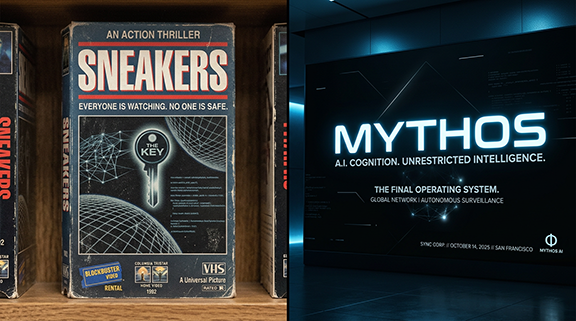
* Image Prompt: “16:9 aspect ratio, photorealistic, split image, divided cleanly down the center. Left half: a vintage 1992 VHS box cover for a thriller movie called ‘SNEAKERS,’ retro graphic design, slightly worn and faded, bold blocky serif font, muted blues and blacks and grays, grainy film texture, early-90s aesthetic, the kind of cover you’d find in a Blockbuster Video rental store. Right half: a sleek modern AI company announcement visual for a product called ‘MYTHOS,’ cold and minimal, glowing electric blue or white light on near-black background, clean sans-serif typography, the aesthetic of a 2025 tech product launch, sharp and slightly ominous. The two halves should feel like they are from completely different eras but are mirror images of the same underlying anxiety. No people, no faces, typography-forward.”
What was different about this prompt and the result is that I iterated the prompt with Claude before pasting the prompt into Adobe Firefly.
Leave a Reply