Judd Apatow’s theory of presidential politics is that the funniest candidate wins, which isn’t a stretch for a comedy writer and director. I used to agree with this, but then Trump came along to complicate it.
Trump never laughs. He doesn’t smile either. Instead, he has that bizarre grimace, a painted rictus. He has won two presidential elections: if the funniest candidate wins, then how can a man who does not enjoy humor be the funniest candidate? It’s a paradox.
This conundrum bothered me afresh after watching former President Barack Obama go toe to comedic toe with Stephen Colbert on The Late Show’s May 5th episode. (You can see most of it on YouTube.)
Obama is funny. Very funny. He always has been, even in dark political moments during his presidency. He also smiles, laughs, and enjoys humor in others.
I believe that the catalyst for Trump’s decision to run for president in 2015 was Obama’s roasting him at the White House Correspondents Dinner in April of 2011. (Excerpts here.) Trump had reveled in the evidence-free conspiracy theory that Obama had not been born in the USA. When Obama and Trump were in the same room at the Correspondents Dinner, Obama dealt some light comedic payback.
Trump’s face in that footage is almost motionless and emotionless. With the insight of the intervening years of watching Trump’s habitual scowls (even on the special edition passport bearing his face) and ad hominem attacks on reporters who ask him tough questions (the word “disgrace” features prominently in these) instead of answering them, looking back at that footage I see barely-controlled rage that anyone would have the temerity to make fun of him, even a US President.
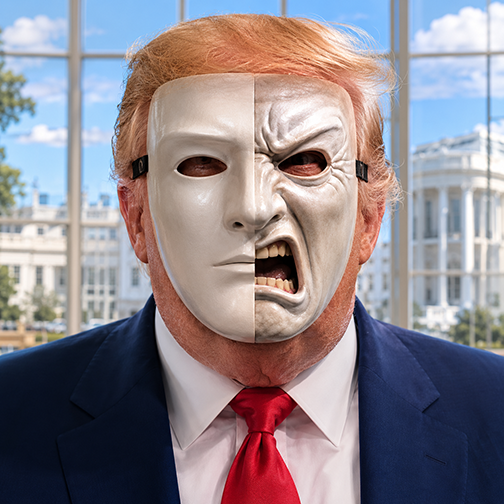
For Trump, I believe humor falls into one of two buckets.
In the first bucket, humor means that attention is going to somebody, anybody other than Donald Trump, even if that person is of the hypothetical “a guy walks into a bar” variety.
Trump’s greatest gift is his understanding of attention. For most people, a positive story about them and a negative story would cancel each other out. This is how pollsters think. Trump knows this is nonsense: one positive story plus one negative story equal two stories—double the attention. Trump understands “Attention Quotient” or AQ, a no-lose media equation; it also explains his obsession with The New York Times.
Trump hoards attention like a dragon hoards gold because it is the source of his power.
Except for one kind of attention.
In the second bucket, humor directed at Trump, mockery, satire, is that wrong kind of attention. He luxuriates equally in adulation and hatred because in both his importance is central.
If somebody makes fun of Trump, what that means is that he does not deserve the other forms of attention. A figure of fun is too silly to be hated or loved.
This is why the most recent seasons of South Park are so devastatingly funny: they depict Trump as a ridiculous, small-membered, Satan-loving (literally), clown.
Why doesn’t Trump laugh? Because one form of humor steals attention from him and the other gives him the wrong kind of attention. To him, there’s nothing funny about either.
Even if I’m right about all of this, it doesn’t untangle the paradox of how a man who doesn’t laugh is funny enough to win the presidency twice.
And Trump is funny, even if he doesn’t laugh himself. His humor is all of one piece of cloth in which he exerts dominance, violates norms, and puts himself at the center of attention: an exercise of power.
Early examples of Trump’s humor were his nicknames for political opponents: “Crooked Hillary,” “Sleepy Joe,” “Little Marco.” Each time he used them, he asserted his own power of representation.
Just last week, Trump joked that he’d leave office, “eight or nine years from now,” which cracked the White House audience up. In that joke, Trump conveyed that he wanted to stay in office past his two-term limit, violating that norm (and the Constitution), exerting dominance, and making himself the center of attention.
This is another way that Trump uses humor: to test-drive and workshop ideas in real time to see how people react. Since his audience laughed rather than booing or staying silent, Trump now knows that for at least one slice of the American public his remaining in office is thinkable.
If Apatow is right, then it means that Trump was funnier than all his primary opponents in 2015, funnier than Hillary Clinton, and funnier than Kamala Harris in 2024. But it also means that he wasn’t funnier than Joe Biden in 2020, and Biden wasn’t a laugh riot at the best of times.
That leaves me with a final question: how funny is JD Vance?
Note: To get articles like this one—plus a lot more goodies and things worth your attention—please subscribe to my free weekly newsletter.
* Image Prompt: “A photorealistic image of an 80 year old white man who is overweight, wears a blue suit with a red tie and has thinning, combed-over orange blonde hair. He is facing us directly. He is wearing a comedy/tragedy mask but instead of comedy and tragedy, on the left side of the mask the expression is complete neutrality, and on the right side of the mast the expression is rage. 6×6 dimensions. We should be close up so that we can see the man’s shoulders. Behind him are windows looking out onto a sunny day with white-colored, government looking buildings nearby.”
Leave a Reply