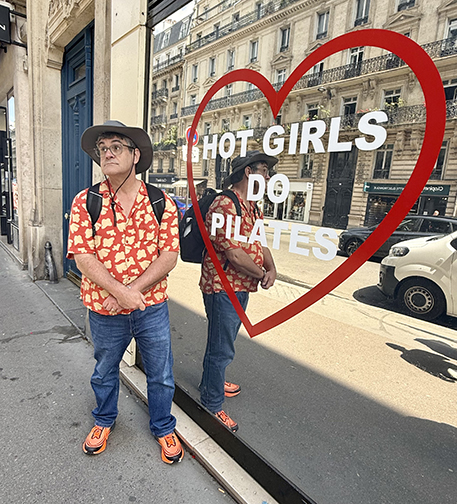
Adventures in Paris
La Profesora joined me in Paris for the RMN Europe Ascendant Boot Camp last week, which I programmed and hosted. After, we stuck around for the long weekend.
The thing I love most about Paris is its excess of everyday aesthetics. A dozen years ago, I wrote “Paris as a Way of Seeing,” and it’s still the case that Paris has an unusual commitment to aesthetics, and that commitment draws a special form of attention from visitors.
Waiters: At a post Boot Camp team dinner, the waiter at a Lebanese restaurant did so much more than serve dinner in a friendly way: he gave a theatrical performance when doing things so simple as handing out forks. (He would start to hand one to a guy, then pull away to hand it to a gal at the last moment; it was delightful.) Later, we asked him to take a picture of us, and when one of the team was slow to turn around to face the camera, he assumed a posture of such complete exasperation that he deserves to be on Broadway. He is not the only performative waiter we encountered.
Immersive Marketing: Walking down the Champs-Élysées, La Profesora and I wandered into what looked like a museum exhibit called Pop! Art! Car!—
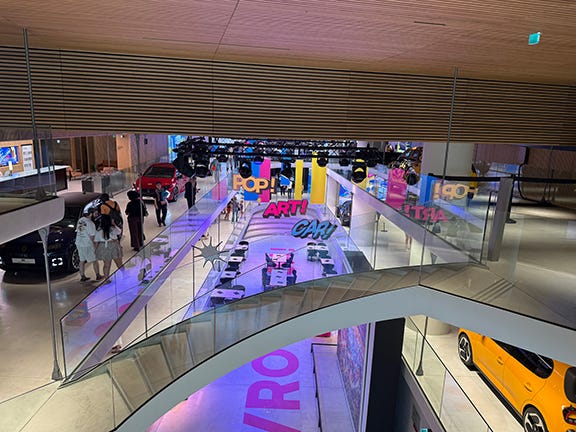
It turned out to be a mini-expo for Renault, and it was the best example of immersive marketing I’ve ever experienced. Set up in a Guggenheim-like spiral (albeit much smaller), we walked up through concept cars—
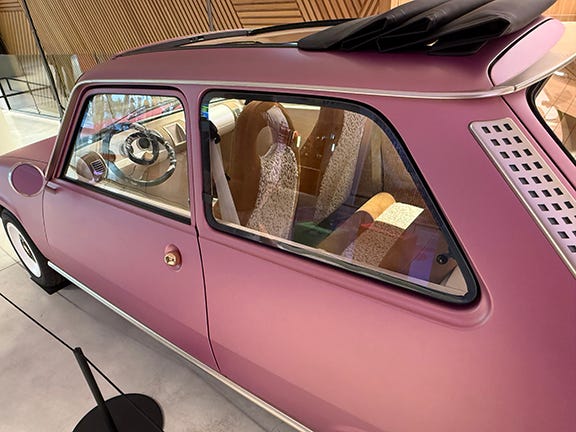
—and then reached for-sale-now models. Before that exhibit, I never would have considered test-driving a Renault, but now I would.
Food Festival: We were planning to go to a museum, but then La Profesora (who speaks and reads French), noticed an ad in the Metro for a food festival at the Grand Palais:
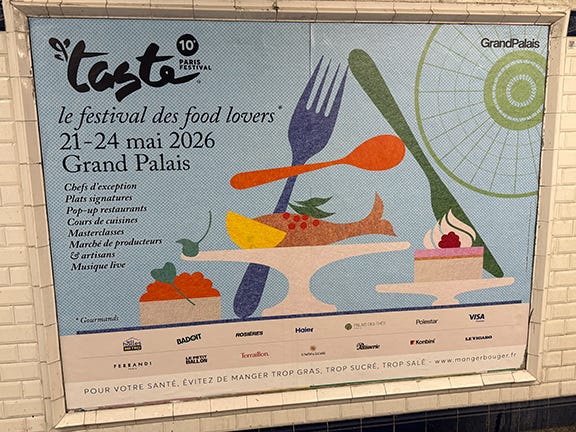
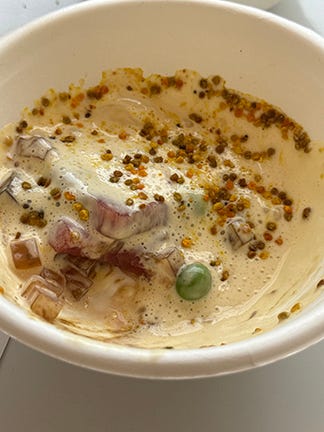
The museum would be there the next time, she reasoned, so we decided to check out the festival. To our pleasant surprise, we were among a very few tourists at the festival: it was mostly Parisians. The Palais was hot, but lively, and the exhibits were delightful. A seafood restaurant called LAVA had a long line and a boisterous guy yelling into a megaphone to encourage folks to come. The noise and wait were worth it. Here’s a picture of a tuna dish in foam with peas:
My favorite exhibit was by Charbon, a distillery that makes whiskey from sesame:
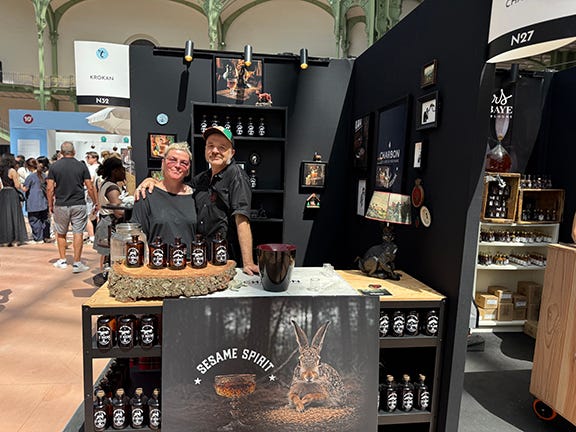
Sam, who co-founded the company with his wife Stéphanie, took us through a tasting of all five varieties. They are all delicious and strong: a thimble-full goes a long way. We bought Le Brulé, peaty and smoky like my favorite Islay scotches. Here’s hoping they get distribution in the US!
One last image from a washroom at a restaurant near Saint-Germain-des-Prés:
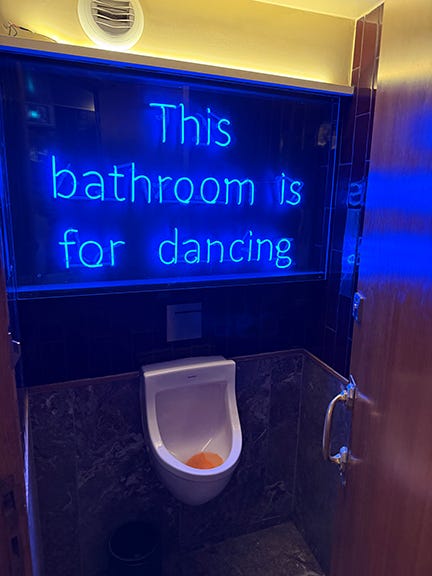
It’s amusing in at least two ways: 1. it’s in English; 2. if one were to take the sign as an instruction, the likelihood of the urinator hitting the target is somewhat dim.
A Claude Unlock
I’m working (slowly) on a new book. This often requires deep focus, and as I’ve shared before when I need this sort of focus I often turn to fountain pens and nice paper.
The downside of doing this is that it means I later need to transcribe those notes into Scrivener (the word processor I use for longer pieces). I like transcribing these notes because it reinforces them in my memory, but sometimes I just don’t have the bandwidth to do it.
As we were getting ready to leave for Paris, packing in a hurry (sorry, Mom), I realized I had a cluster of notes that I hadn’t transcribed but wanted to have with me.
Google had sent a marketing email about how Gemini can turn class notes into study guides, which made me wonder if Gemini could transcribe my notes. I took photos of my notes and then uploaded them to my computer. I tried Gemini, but its accuracy rate was unsatisfactory, as was that of ChatGPT and Perplexity.
Claude, however, did a great job: 95% accuracy, and it was easy for me to make needed corrections. You can see for yourself:
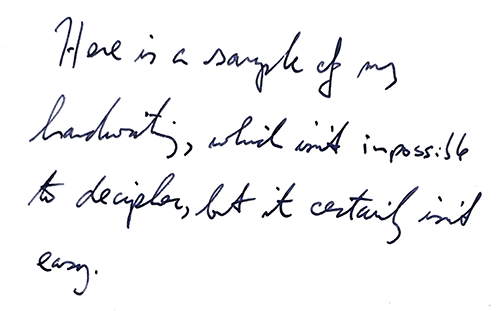
Claude’s transcription:
“Here is a sample of my handwriting, which isn’t impossible to decipher, but it certainly isn’t easy.”
There are a lot of Optical Character Recognition (OCR) platforms out there, some free and some expensive. Claude, however, is my go-to AI tool, and it knows a lot about me since I activated the “Search and reference chats” and “Generate memory from chat history” options.
Having handwriting-to-digital-text transcription built into my most-used tool is amazing: it has the ability to unlock the value of the thinking in my handwritten notes, which before were trapped in paper and ink.
Eventually, I suspect that this sort of transcription will be built into many different platforms. My dream is that Evernote, where I have scans of thousands of notes, will be able to churn through everything in the background, making my handwritten notes searchable.
The downside is that this would also make my notes hackable, so some things will have to stay on paper and ink. Privacy and digital technologies don’t mix well.
Note: if you would like to receive articles like these, plus a whole lot more, via email, please subscribe to my free weekly newsletter!
Leave a Reply