Art and other stimuli exist to nudge us out of automatic recognition into seeing things afresh, which is more important now than ever.
Oh, happy day! My son returned last night from five months of study abroad in Auckland. La Profesora, his girlfriend, and I greeted him at the airport, after which we went our separate ways: La Profesora and I to a dinner party, the other two off to their own devices.
How, I wonder, has this experience changed my son? It surely has, but what will he keep private and what tendrils of subterranean growth will creep up into daylight visibility? One tendril has already popped into view. He came downstairs after the first burst of unpacking and said, “I have a lot of clothes.”
When he left in February, he brought two pieces of luggage: one suitcase and a duffel. He has been living for a season and a half with a limited wardrobe, so now the closets at home seem to bulge. He has begun to prune.
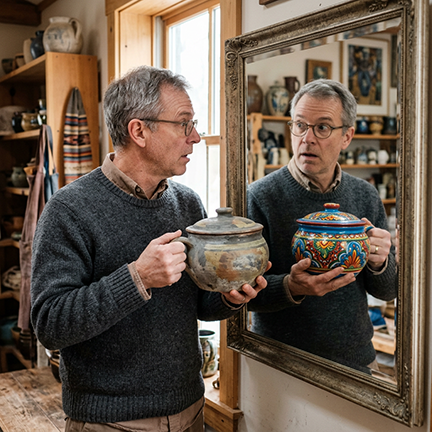
My son’s time away from home and from his stuff allowed him to see things afresh upon his return, instead of merely recognizing them. Seeing versus recognizing is an important distinction that I first ran into in the work of the Russian Formalist critic Viktor Shklovsky.
In his famous (for lit crit types anyway) 1917 essay “Art as Device,” Shklovsky coined the term “ostranenie,” which means “defamiliarization” or (my preference) “making things strange.” It has also been translated as “enstrangement,” which is itself a strange-looking, strange-sounding word that amplifies the making-strangeness of the idea of ostranenie.
Ostranenie is one of the most useful ideas I’ve encountered. For Shklovsky, ostranenie explains the purpose of art, which is to make things strange so that we can see them again, instead of merely recognizing them. But ostranenie’s value as a concept extends beyond why we have art and what art does to our minds.
I’ve written about ostranenie before (in “Wonder Moments”), where I compared Shklovsky’s recognizing vs. seeing to Daniel Kahneman’s System 1 (thinking fast) vs. System 2 (thinking slow) and to schema-driven processing vs. data-driven processing in social psychology. In all three distinctions, the tradeoff is between getting through a high volume of information quickly and being able to understand, appreciate, or question pieces of information along the way.
It has never been more important or more difficult to evaluate information, and the reason for both the importance and the difficulty is how much more information there is now, by many orders of magnitude, than there ever has been before. We’ve been talking about information overload (and filter failure) since the dawn of the publicly available internet. Now, with the arrival of publicly available AI-generated information, the problem has become incomprehensibly bigger.
Information overload is turning into an information fugue state where we don’t know what is real, what is hallucination, and who we are in relation to all this information.
An analog oasis?
My son’s return from New Zealand (and realization that he has a lot of clothes) sparked a new question about ostranenie: is it—and, if so, how much is it—analog by necessity?
The answer, I suspect, is that ostranenie is not inherently analog, but analog objects and environments better the odds at escaping recognition and seeing things anew. Analog has more friction than digital, and friction increases dwell time with an idea, which is key to seeing rather than recognizing.
Walking through a museum or a garden, listening to birdsong, reading a paper book or magazine or newspaper, cooking rather than microwaving, listening to live music, attending theater or a movie in a movie theater, writing with a fountain pen on nice paper rather than tapping on a piece of glass or a keyboard, any of these things can provoke seeing rather than recognition.
However, the opportunity cost of single-tasking—that is, doing any of those things without also looking at your phone—gets harder and harder.
The enstranging effect of art and other startling stimuli (the “wonder moments” I mentioned before) pushes us out of the whirligig of digital information into moments of contemplation (Kahneman’s “thinking slow”)… if we get lucky.
We get lucky less and less often. The cover story of the newest (August) issue of The Atlantic is “The Age of Reading is Over,” by Rose Horowitch. It’s a long, thoughtful piece.
For Horowitch, the decline of reading—with its concomitant declines in contemplation, comprehension, and critical thinking—causes our polarized politics and newly “postliterate,” superficial, fact-agnostic society. It’s a dystopic piece that provides scant hope.
I’m more optimistic, although not much. The mental muscle we need to build doesn’t necessarily require reading, although reading yields fathomless benefits.
The first step is to get away from screens, step outside, look at things, look at other people, and strive for patience while we do it.
Here are two final questions.
First, what are the minimum viable conditions for ostranenie—for seeing instead of recognizing? If the answer is, “five months in New Zealand,” like my son’s experience, then hope is lost.
Second, can we (and how can we) as a species embrace seeing as part of mental health?
Addictive, attention-sucking algorithms stack the odds against us the way addictive processed foods make healthy eating a struggle. However, lots of folks still try to eat healthily and exercise. We don’t have a similar consensus that higher friction contemplation is healthy thinking.
We need it.
Note: To get articles like this one, plus many more goodies and things worth your attention, please subscribe to my free weekly newsletter!
* Image Prompt: “A 4×4 photorealistic image. A middle aged white man wearing glasses holds a painted clay cooking pot up to a mirror. In real life, the clay pot has muted colors, almost gray. In the mirror, the paint on the clay pot has vibrant, vivid colors. The man has a mildly surprised expression, looking at the mirror image of the clay pot.” Firefly got it right the first time, which is rare. Note that the man’s wedding ring switches hands between the two images.
Leave a Reply