Will untrustworthy AI products and advertising breathe new life into retail because that’s where trustable humans are?
It was spring. I walked the streets of New Delhi reckoning with an urgent Number Two and no place to deposit it. Public toilets, at least in that hood, seemed not a high municipal priority.
Then, through gastrointestinal-distress-blurred vision, in the distance I spied golden arches, a yellow sign inspired hope about relieving my brown distress. McDonald’s. Home—at least in my country half a world away—to reliably clean restrooms.
When I arrived, there was, of course, a line. The people in front of me used their restroom sojourns to read the complete novels of Herman Hesse in the original German, work on corporate tax preparation, and unravel complex finger movements for a new piece of sitar music.
At last, it was my turn. A joyful experience. After, I ordered much more food from McDonald’s than I could eat, particularly given the weak state of my colonic recovery, but I did so as a financial thank you to convey the magnitude of my gratitude, toasting the memory of Ray Kroc as I did.
This is what it means both to trust a brand and to have that trust remain unbroken.
Different business leaders define a brand as “a promise kept,” and it’s worth digging into the nature of that promise because it’s not reducible to one transaction.
For example, when we are time pressed and need groceries, La Profesora and I frequent our nearby New Seasons. We congratulate ourselves that this is only the second most expensive grocery chain in Portland. It’s a distant second to Zupan’s, where you measure the cost at checkout in the number of internal organs you’ve traded for artisanal blue cheese made by druids in the nearby Columbia Gorge, olive oil so virginal it blushes to be put in a shopping cart, and steak from agreeable cows that cheerfully drop dead when their time comes.
New Seasons is not that pricey, and it is dependable. We know the buyers stock quality items, curate them with attention, and stand behind them in the rare event when something goes awry. We also shop at other places, but when we go to New Seasons, we are trading money for time.
It is, I believe, easier to build brand trust with analog things than digital. You might now be thinking, “but what about Amazon?” That’s fair, but Amazon has earned our trust because it mostly delivers physical items to us, speedily and at prices that are at least fair. The proof isn’t in the frictionless shopping experience: it’s in the physical thing we pull out of the box or envelope later.
However, Amazon’s trustworthiness is eroding as fraudulent and poor-quality items that aren’t worth the cost of shipping flood its marketplace. Temu, Shein, and other purveyors of ultra-cheap, low-quality products with high production-value photos also compete for our impulse purchases with unsatisfying results.
And things are getting even worse with AI-created shopping, products, and advertising.
Caveat Emptor
A few recent articles have charted new territory in the unreliability of AI-driven shopping.
In her hilarious and worrisome piece, “I Got Slopped” (NYT $), Kashmir Hill investigates the tsunami of low-quality, AI-generated biographies that flood Amazon, including one of herself that bears little resemblance to her real life. She interviews Bill Johns, who has used ChatGPT to create 445 books that he sells on Amazon. Even if he sells only a few copies of each title a year, it keeps him in bar money.
Likewise, this fascinating five-minute video from The New York Times describes AI-generated influencers hawking health supplements that don’t bestow the promised medical miracles and can also make people sick.
In an insightful Substack by my friend Shiv Singh, he argues that we cannot rely on human taste remaining an advantage over AI:
AI does not need taste in the philosophical sense to become the organizational arbiter of taste. It only needs to perform the evaluative functions associated with taste well enough, consistently enough, and cheaply enough that companies begin relying on its rankings.
However, Shiv goes on to point out that “preference optimization can improve quality while narrowing possibility,” which in plainer English means that algorithms make everything seem the same and bland. He also links to a worthwhile NYT ($) piece by Amy Odell about “fashion slop.”
Analog Trust Gets More Valuable in an AI World
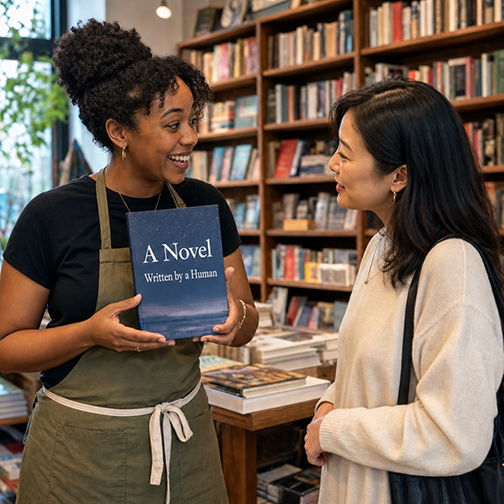
One reason why AI-driven taste-making can work is that we don’t care much about most of our decisions. We only optimize a small percentage of our choices, satisficingthe rest. When we optimize, we can spend a lot of time happily looking for the right product, the perfect match.
With satisficing, we only need the good enough product, not the perfect one.
Endless AI slop products make finding good enough stuff harder, which is frustrating because these are the decisions that we want to be fast and easy.
This is an opportunity for brick and mortar retail in the age of AI slop. It’s getting riskier to buy a book you haven’t heard about on Amazon because the book may not even have been written by a human and may be inaccurate and poorly written. It’s getting riskier to trust a good-looking influencer about a new vitamin because that influencer may not be a fellow human.
One solution to this problem is to go to a store where you can see a product, inspect it, and talk with a merchant about whether it’s any good. The merchant has incentive to give you good information because she has skin in the game. If she leads you astray, then you won’t come back. If she earns your trust, you might.
This is not the case for a shady manufacturer selling you a shoddy shirt on a direct-to-consumer platform for $7.56. If—excuse me, when—the shirt falls apart after wearing or washing it once, it’s not worthwhile to pursue a refund, and it may not be possible to get one.
In my town, I regularly see exhortations to shop local because it’s the right thing to do to spend my money on merchants who live in the same community. That’s true, but it’s an ineffective argument because there’s nothing in it for me besides spending more.
The better argument is that shopping local—or at any brick and mortar—saves me time on my satisficing decisions. It might cost a little more, but that is the premium that trust, that promises kept, earns and deserves.
Note: To get articles like this one—plus more goodies and things worth your attention—sent straight to your inbox, subscribe to my free weekly newsletter!
* Image Prompt: “Please create a 5×5 photorealistic image of two women, both of indeterminate age, in a bookstore talking with each other. One woman is a merchant who works in the store. She is holding up a book that she is excitedly describing to the other woman, who is a customer. The customer is eagerly listening. The title of the book on the cover reads, “A Novel” on one line and “Written by a Human” in smaller font below. The women should not both be white.” ChatGPT nailed it on the first try, but I did ask it to make “Written by a Human” bigger because of the size of the image in this newsletter.
Leave a Reply