Beyond being able to tell what is real and what is AI-generated, how important is that ability to us?
In my last post, I shared a microfiction (1,000 words or less), a short story called Best Laid Plans about Piers Elder, a man who tries to unite people by inventing a common enemy, only to suffer unexpected and dire consequences.
This time, I’ll explore how realistic the story is or isn’t. You don’t have to read “Best Laid Plans” (although it ain’t bad and it’s only 580 words) to understand this week’s piece, but fair warning: Thar Be Spoilers Ahead!
A pressing question for our species is, “How can we know what is real?” AI makes this problem worse because it has democratized lying, fakery, misinformation, and downright disinformation. With AI, it’s cheap and easy to create things that look real on quick examination… and most of us don’t look twice.
However, AI did not invent these problems. Around 370 BCE, in the Phaedrus, Plato worried about the reliability of written information versus things people say to your face. There has been photo fakery as long as there have been photos. Every new technology’s arrival brings anxiety about what it means for how we experience reality.
I’ve written about the difficulties in knowing what is real before. For example, I ended 2022 by exploring Robert A. Heinlein’s 1960s notion of a “Fair Witness” to serve as a certification mechanism for what is out there, and how we might benefit it from it today.
“Best Laid Plans” is about something different: it’s about whether we care what is real and what isn’t.
In the microfiction, Piers Elder is transparent that his creation of troglodytic Toynbeeians is just that: a creation. It doesn’t matter because more and more people take on the identity of Toynbeeians as a form of protest and to identify themselves as marginalized. Eventually, Toynbeeian activists wind up killing Elder, even though that isn’t their goal.
Is this realistic? Sadly, I think so.
Here’s why.
Identity isn’t as fixed as we would sometimes like it to be.
For example, much of the conservative and fundamentalist dislike of trans people, anybody who uses atypical pronouns, and folks who identify as something different from their identity at birth is political jazz hands: distractions from thorny social problems.
It’s easier to say that life would be better if everybody with a penis used one washroom and everybody with a vagina used another because those are simple, imperfect solutions to complex problems that only a small percentage of people have to grapple with. Culture wars distract us from bigger things like a dysfunctional health care system set up by corporations for their profit, or the slow elimination of human rights for people who have brown skin rather than pink skin.
However, progressive identity politics do make some people anxious. If that person’s identity isn’t stable, then what does that say about my identity? Conservative culture wars exploit this.
Even in more accepting times, identity is always embattled. I don’t like using the passive voice in general, but who is doing the battling can be hard to see. Maurice Sendak once observed, in his boundless empathy, that it’s hard to be little, to be a child. I agree. I also think it’s just hard to be a person—any kind of person—because nobody fits with precision into whatever cultural box is close by.
In the microfiction, some folks see something in Elder’s notion of Toynbeeians that they recognize: “that’s like me.” It’s like joining a club in school, being an overt fan of Harry Potter or Star Trek or a sports team. But the stakes are higher.
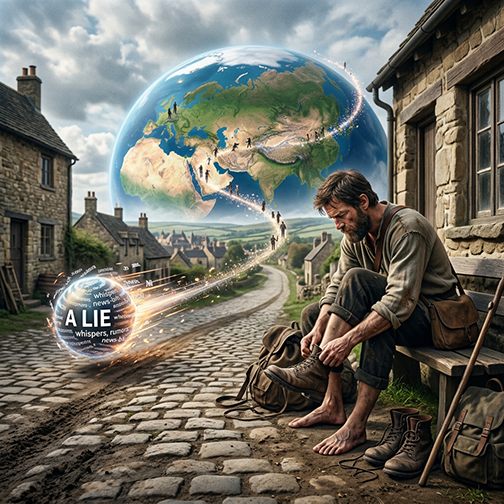
“A lie will go round the world while truth is pulling its boots on.”
The old proverb can be right—there’s often something yummy about a salacious idea where the underlying, closer-to-reality story is bland—but lies and truths are hard categories.
More important: cognitive dissonance is whatever the opposite of a superpower is—a low weakness? It’s also inescapable. Given a choice between data and our beliefs, most of us choose our beliefs.
The classic example:
Smoking is bad for you. The Surgeon General says so.
Yeah, but my Uncle Jerry smoked three packs a day and lived until he was 90, so I have good genes.
Stories are more powerful than dry facts, and the self-deluding smoker has a story with a hero (Uncle Jerry). The Surgeon General’s Warning (there are four, but the one I know best is “Smoking Causes Lung Cancer, Heart Disease, Emphysema, And May Complicate Pregnancy”) isn’t a story, and its use of the word “may” gives fuel to the fires of false hope.
When beliefs go tribal, cognitive dissonance takes steroids and starts pumping iron.
In a tribe, to belong you must believe. If part of a tribe’s mythology is disbelief in things that don’t come from the tribe (which might include science, logic, morality, evidence), then there is no exit from that mythology.
A tribe can be an in-real-life community, but it can also be the creation of media. If you look at the Ad Fontes Media Bias Chart, the farther you get from the green box at the top (in any direction), the deeper into tribal territory you go.
Tribes aren’t just in the news. My late friend Frederick Crews renounced his belief in Freudian theory: he was a noted Freudian literary critic until he had an unusual awakening. He once shared that the people who were still Freudian critics always diagnosed his departure from Freud in Freudian terms. “Ah, you’re in an Oedipal conflict with Freud,” they’d say. “No,” Fred would reply. “It’s just not science,” but they couldn’t hear that because Freudianism is a self-perpetuating Möbius loop.
In the microfiction, Elder tells believers that ToynbeeLand doesn’t exist and that he made it up. He asks them to look at satellite photos of the region that will show there is no island there. The believers reply, “Satellite photos can be altered.”
“Who am I?” and “What’s out there?” are two powerful and unanswerable questions.
When God introduces himself as “I am who I am” to Moses in Exodus, the reason that’s a gesture of power is that God has an answer to the question: Who am I?
Popeye has a similar answer: “I yam what I yam, and that’s all that I yam. I’m Popeye the Sailor Man!”
Most of us aren’t as lucky as God or Popeye.
Note: To get articles like this one—plus a lot more goodies and things worth your attention—direct via email, please subscribe to my free weekly newsletter.
* Image Prompt: “Please create a 4×4 photorealistic illustration of this famous proverb: ‘A lie will go round the world while truth is pulling its boots on.’”
Leave a Reply